What I learned at Lollapalooza.

I just returned from three days at Lollapalooza with my daughters. Great time with the girls.  Outstanding festival – really well planned and run.  (Chicago is a fantastic city!)

While I've spent years creating events for youth marketing programs, often from the outside looking in, this gave me chance to experience youth marketing from the mosh pit out.

By and large, the marketing was fairly flat-footed.   The usual branded swag became white noise.  The best efforts came from a handful of marketers whose presence added something to the fan's experience.

The best by far came from my old friends at Toyota.  Their tent wasn't an escape from music – it celebrated music and creative expression.  There you could hop in a Corolla retrofitted to be a four-door photo booth; spin to win some cool prizes; listen to little-known, up-and-coming bands (the roots of Lolla, right?) who performed in the tent and were streamed over the interweb; as well as create art and posters.

Estancia Wines showed that it understood a simple fact about three-day concerts:  people need to sit in the shade.  The Estancia tent was set up like an outdoor ultra-lounge, featuring leather chairs and couches, cafe tables and stools, and, of course, a wine bar.

AOL did a decent job promoting its Lifestream service by setting up a helpful charging station.  Very simple and insightful.

The most well-intended but ineffective effort came from AT&T, which handed out ear buds to promote that it was offering free wi-fi inside the festival.  The only problem was that its wi-fi coverage didn't extend throughout Grant Park. Epic Fail.  (They've learned what veterans of Lolla and Coachella have long known – 3G networks become paralyzed by tens of thousands of people simultaneously blogging, posting, tweeting, texting, poking and uploading.)

My daughter Lauren has a great idea for any marketer gearing up for next year:  Sponsor a tent where fans can decorate and personalize their own "find me" stick, and perhaps upload the image to their friends.  I noticed in the crowd how some people brought poles and sticks decorated with stuffed cats, balloons, jesters, etc – anything they could hoist up to help their friends find them in the sea of fans.

Let me not mislead you into believing that I actually spent three days thinking about this stuff.  It was all about the music.  And here's the music I really loved:

The Strokes
Arcade Fire
The National
Frank Turner
Against Me
The Walkmen
Yeasayer
Matt & Kim
Gogol Bordello (tied with Matt & Kim for the most entertaining band)
Social Distortion
and, of course, Green Day

Me and Green Man are tight.

Why Millennials will save Madison Avenue.

(As published in the Minneapolis Star Tribune.)

Listen in on most brand planning meetings and one word comes up over and over – Millennials.  Sometimes called GenY or EchoBoomers, this is the generation born between 1982 and 2000.  Millennials are no longer solely on the playground; they're running companies (Mark Zuckerberg), entertaining (Rihanna) and winning Olympic Gold (Shaun White).  To marketers, Millennials represent a 76 million strong brand-conscious demographic.

Recently, however, I’ve started viewing this generation through a different lens.  Beyond being a coveted advertising target, the characteristics that define this generation make them extremely well-equipped to re-architect the modern advertising agency.  

I believe this to be true because Millennials are widely viewed as a generation of collaborative, tech-savvy, multicultural, problem-solvers – the very skills necessary to address the questions marketers increasingly voice about their advertising agencies.

Let’s break it down by examining some of the defining traits of Millennials, as outlined by Lynn Lancaster and David Stillman in their recent book, The M-Factor, and examine how a career in advertising meshes with these values.

Millennials are inherently collaborative:  This is a generation that believes we > me.  They’ve been working in teams since kindergarten as classrooms increasingly emphasized group participation.  Soccer became the suburb’s biggest after-school sport because it prizes team flow over star-power.  Advertising is a great profession for people who thrive on collaboration (or “no walls”, as we call it at BD’M).  The agencies that are succeeding are those that have banished silos, where media, creative and strategy form one big mosh pit of ideas.

Millennials are the first multicultural generation:  This generation has grown up in a time in which the U.S. experienced dramatic growth in immigration and racial integration.  Multiculturalism is simply a fact of life for this group, reinforced early on by Sesame Street, and later in the classroom, as well as in film and music.  Let’s face a hard truth:  the advertising industry must do a better job when it comes to diversity. This is not simply a politically correct goal – it is an economic imperative. We're in the business of helping clients connect with main street America.  Agencies succeeded at this over the decades largely because we mirrored the face of America.  This is no longer true, and unless this changes we put at risk our ability to give our clients relevant and intimate customer insights.  Millennials can play a huge role in reshaping the face of agencies and our ability to understand and connect with multicultural America.

Millennials want to be innovators and problem-solvers: Marketers hire us because the lines on the graph are heading the wrong way.  At its core, advertising professionals solve problems by inspiring clients to embrace new solutions.  More and more these solutions involve online, mobile and social media.  Millennials have been training for this job since birth.

Millennials want to feel they are contributing: Boomers and Xers sometimes label Millennials a needy group requiring constant feedback.  To be sure, this is a generation that received trophies for simply participating, not to mention an endless flow of reinforcement from their “helicopter parents.”  Advertising is an excellent career for people who thrive on instant feedback.  In this business you’re either a hero or a goat; there’s nowhere to hide.  Whether you’re writing the TV spot, mapping the online user experience, or crunching the CPMs for the media plan, your work is out there in the white hot spotlight for all to critique. 

Millennials want a job in which they can be heard:  On the night before a pitch, a great idea knows no title.  If you are a so-called “junior” and feel you have the answer, irrespective of the fact that your title has half the syllables as that of your boss, shout out and be prepared to defend your point of view. Anybody who has worked with me knows that I refer to meetings as a full-contact sport.  Come play.

Millennials want to make a difference in the world:  Like it or not, we live in a consumer culture bombarded by media in all its forms.  Smart, talented and creative people can get intimately involved in creating marketing ideas that make a difference.  Witness Starbucks’ support of Red; Pepsi’s strategy to crowd-source world-changing ideas; Target’s support of the arts; GE’s ecomagination; or Ford’s support for the Susan G. Komen Foundation.

Millennials want to express who they are through work:  Good luck expressing yourself in a huge corporation.  Conversely, an agency is like high school for grown ups.  You can earn social currency through your individual sense of style, taste in music, tattoos, social causes or antics at the last party.   We really don’t care if you are gay, straight, indie, emo, conservative or downright crazy, just as long as you have smart ideas and come through when it counts.

To capitalize on the opportunity that Millennials present, the advertising industry has to begin making a clear case why this profession should attract this generation's best and brightest.  (Anybody who hasn’t viewed Rory Sutherland’s 2009 speech at TED –“Life lessons from an ad man.”– should take a few moments to watch it and reflect on the economic value and cultural impact we create when we do our jobs well.)

The 4As must ramp up campus recruiting and attract talented graduates by connecting the values of this generation with the unique career opportunities advertising agencies present – a career that stands at the nexus of business, media, entertainment, technology, pop culture and any and all new trends.
Most importantly, senior leaders of advertising agencies need to stop dwelling on what they had to do back in the day to get ahead and instead unleash the creativity and energy of the twenty-somethings buried in their agencies.  Any agency that is having a hard time grappling with social and digital media is simply an agency that hasn’t tapped its in-house experts – its Millennials.

Jobs = income = demand = profits. Not vice versa.

Yesterday I attended a leadership meeting for the Merage School of Business at the University of California Irvine, where I serve as Vice Chair of the Dean's Advisory Board.

At the meeting Paul Merage, whose gift and vision has helped propel the school's progress, reiterated his vision that the U.S. is in the midst of its third economic epoch. The current Innovation Economy is radically transforming our country from its earlier roots in its industrial and agrarian based economies. As Paul points out, our country faces twin challenges if it hopes to succeed in this economy: we need a new generation of executives to lead in a global innovation economy and we also need a well educated work force to ensure these innovation-driven jobs stay at home.


This same theme is put forward in a must-read article in Business Week by Andy Grove, former CEO of Intel. The legendary Silicon Valley leader makes a compelling case for why we need to fix America through jobs and not Wall Street profits, particularly when there is 10x more tech jobs in China for every one in the U.S. Sure, our jobs pay more, but left unchecked this is the path toward wider class and economic divisions in our country — a highly unsustainable economic and social model.

While Henry Ford is rightly credited with pioneering mass production, what he actually created was a viable middle class to consume these mass-produced and newly affordable cars, appliances and, later, TVs. Higher paying manufacturing jobs creates real income which fuels consumption which underpins demand. QED.

Winning is sweet.

Today Bissell announced it has chosen BD'M to handle the launch of an exciting and important new brand.  Everyone at the agency who worked on the pitch was so taken by the culture and people and Bissell.  And the new product is definitely going to make a statement.  We're looking forward to a very good partnership.

So far 2010 is shaping up to be a year of quiet momentum at the agency.  In addition to winning this assignment from Bissell, earlier in the year Pulte Group named BD'M as AOR for its Del Webb brand; UnitedHealth Group enlisted us to lead a brand positioning and identity project; and, along with our partners at United Airlines, we just won an EFFIE for our Travel Options campaign.

The people at BD'M have given their all and more this year, and it's beginning to pay off.  Let's hope the Great Recession is finally giving way to the Great Recovery!

Opt for success.

Last week BD'M and United Airlines were awarded an EFFIE by the American Marketing Association for the success of its Travel Options campaign.

Travel Options by United is a marketing program that enables customers to purchase a la carte the premium perks traditionally enjoyed only by elite business travelers – e.g., using the faster security line, boarding early, enjoying extra legroom in Economy Plus, shipping your bags directly to your hotel room, lounging in the Red Carpet Club.

The agency's challenge was to launch Travel Options in a way that separated it from things like baggage fees and other price increases airlines had to implement to combat volatile fuel prices and a drop in air travel during the recession.


United and BD'M made this a success by digging deep to understand the product from the customer's point of view, mapping every conceivable touchpoint along the customer's journey, and adopting a very collaborative test and learn approach.  But perhaps real magic behind the program was the quirky little word we happened upon:  "Opt."  This simple idea not only conveyed choice, but became the glue which held together the full range of products and services United offers within Travel Options.

While BD'M has earned a number of accolades during this past year, including a Gold Lion in Film at Cannes and the distinction of being named "Best Small Agency in the U.S." by the 4As, the EFFIE Award represents an agency at its best – creating distinctive work that delivers superior results for its clients.

What is a brand?

A column on adage.com today discusses a widely known secret in our industry – we're in the brand-building business, yet no two professionals seem to share the same definition of a brand.

Some define a brand as a promise.  Some define it as an idea.  While others define a brand as mash-up of rational and emotional benefits.  There's likely an element of truthiness to each definition.

The article challenged me to set down in writing my beliefs about brands – a point-of-view formed over the years through different experiences and inputs.  So here goes...


Brands are based on an empathetic relationship with customers.

When I grew up at Ogilvy, Charlotte Beers used to preach that brands are defined by relationships.  That got me thinking, and over the years I tightened that definition to focus on the power of empathy.  I believe people choose brands the same way they choose their friends. Walk into a crowded party where you don't know a soul and notice who you end up chatting with – someone with whom you have something in common.

Empathy is how we bond with one another; it is also how brands bond with customers.  We gravitate toward brands that get us; that share our sense of humor; that share our values; that make us feel good about ourselves.  Define the basis of your brand's empathy toward its customers and you'll get to the essential truth of your brand.

More and more we are witnessing a third party in this relationship – our peers.  In a social media environment, brands are increasingly based on the relationship that exists between the product and the customer and the other customers who use the product.  This observation is why I coined the term wikibranding.  (My former boss at Saatchi, Kevin Roberts wrote a great book called Lovemarks; perhaps his sequel should be "Brands: A menage a trois.")

Brand equity is not a static metric – it is the combination of four essential dynamics:  differentiation, relevance, esteem and knowledge.

When I was President of Y&R Irvine I worked closely with a brand equity model called Brand Asset Valuator.  BAV, the world's largest database on brand equity, demonstrates across hundreds of categories, time after time, country after country, that brand equity is built by the sequence and relationship between a brand's levels of differentiation, relevance, esteem and knowledge (aka, DREK, a very unfortunate acronym).  Of these four dyanamics, relevance and differentiation are most important:  relvance = volume, while differentiation = margin.  Define a specific and tangible strategy for these dynamics and you will have a clear plan for building brand equity.

Experiences transform brand image into brand beliefs.

Customers judge brands on what they do, not just by what they say.  This has always been true, but is amplified ten-fold in a social media world.  When I see a compelling brand ad I will absorb it and remember it.  When I engage a brand in a unique experience – sampling, a cool app, helpful online experience, an event – I will tweet about it.

Great brands tell great stories.

Stories help us understand.  They convey meaning.  And in a fast moving world, meaning trumps information.  Too many brands get bogged down in lists of nouns and adjectives. Brands are verbs; like characters in a story, they do things.

The approach I've developed over time for creating persuasive brand narratives involves identifying your archetypal personality (the universal characters that form our collective unconscious), the hero's journey (the brand's true north, why it exists) and conflict (great literature hinges on a clearly defined antagonist; great brands define what they stand for by being equally clear about what they oppose).

Alas, if it was only that easy.  Greatness is in the execution.  And some brands simply out-execute other brands.  They convey an infectious sense of momentum through purposeful innovation.  And they embrace marketing's "new normal" and eschew tired distinctions between offline and online, traditional and nontraditional.

In the end, one may debate whether I'm right or wrong, but not where I stand on the issue; nor the fact that I've been fortunate to have worked for some smart people over my career.  Thank you all.

Can Cadillac lead again?


A while back I was interviewed for a piece on how Cadillac can regain its cool factor.  The new spots from BBH are visually stunning and a step in the right direction.  But the line "The Mark of Leadership" leaves me wondering how Cadillac intends to lead.  Leadership in performance?  Leadership in design? Leadership in technology?

If the answer is "yes" to all three, that is wishful thinking because it is not singleminded.  Cadillac's identity is so fuzzy that it requires nothing short of a laser-like focus on one theme.  In the piece I wrote I suggested technology, which by the way is a singleminded platform that can be used to support a range of messages, including safety, performance and even design.

Facebook or deodorant: What matters more?

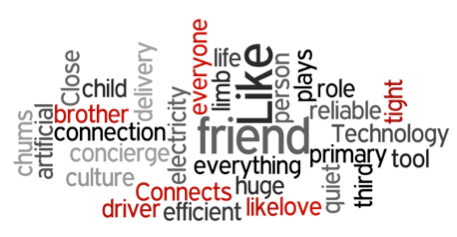
I recently conducted a survey via social media to better understand our relationship with the personal technologies that increasingly define our daily lives.  After all, we’re glued to smart phones, addicted to Facebook, Twitter and texting, and seem to be caught in an endless hunt for wi-fi.

The survey explored a range of questions, such as how we personify our relationship with technology, how our life might change if we had to live without our favorite gadget for a year, as well as what we’d be willing to sacrifice in order to keep our favorite tech (Sleep? Deodorant? Proper nutrition?).

Boomers and Xers display the most angst over whether our addiction to technology is good or bad, in large part because we can recall a time when we weren’t tethered to work 24/7.  Among Gen Y respondents this issue is a nonstarter – like debating the merits of electricity. (Hasn’t the entire knowledge base of the human race always been two clicks away?)

We have a love/hate relationship with our personal technologies.  We love it because it’s like a personal assistant, helping to keep us in the know and be productive.

We hate it when it reveals things about us we’re not proud of – e.g., we’re socially needy, we’re workaholics, we can’t control an obvious addiction.
A few themes emerged.

Technology is our concierge:  We accomplish more things more easily.   Our smart phone is like a best friend – always there, always helping us. 
  • “Technology is like a brother to me.”
  • “A valued assistant.”
  • “Technology is like my third child.  It plays a hugely significant role in my life.”
  • “We’re tight, me and technology.  Close chums.”
  • “It’s like electricity.  Always there.”

Technology enslaves us:  We are tethered 24/7.  While respondents see this as helpful to our personal relationships, it comes at the price of always being “at work.” Gen Y respondents seem to fear that being off the grid equates with being socially irrelevant.
  • “Addicted and in constant pursuit of more.”
  • “Cell phones have become a socially acceptable drug with no cure.”
  • “It’s a devil and a saint.”
  • “If I don’t respond to a my friend’s text right away it’s taken as an insult.”
 
Hygiene matters less than connectivity:  Respondents would give up deodorant before giving up their favorite technology – perhaps a sign that our personal technologies have isolated us, so poor hygiene might not matter much.
  • “I’m locked away emailing most of the day so giving up deodorant wouldn’t be an issue.”
  • “I’m sure there are plenty of unwashed, staying up all night Facebooking and Dorito-eating folks descending into that abyss right now.”

We hunger for more meaningful connections:  Because of texting and Facebook, our personal connections are broad but not deep.  This became evident as respondents reflected on how their life would change if they gave up their favorite personal technologies for a year:
  • “My personal interactions would be narrower, but deeper.”
  • “Less texting, more face to face.”
  • “Less time ignoring caller ID and actually picking up the phone and realizing someone really did need to talk to me at that moment.”
  • “I’d probably have trouble handling the small daily stuff but might actually have more time to focus on big important issues and relationships.”
Clearly, there is no turning back.  Nor should we.  There are countless ways for consumer technology companies to make technology more of a friend and less of a frenemy.  Nintendo’s Wii has been successful because it brought back face-to-face interaction to gaming.  Apple’s success is due in large part to how its design and functionality makes technology simple, inviting and less intrusive.  Bing has picked up market share by addressing the issue of information overload, smartly positioning itself as a decision engine.  And Best Buy’s “twelp force” has brought a degree of humanity and personalization to the act of shopping for electronics online.

The same old "new normal"?

Today I saw a study on "The New Affluents" and how they will be behave differently from previous generations of people with more dollars than sense.

According to this study, affluent Americans are now into self-expression, not status.  They will not buy anything to impress others because conspicuous consumption is out.  Brand choices will be guided by perceptions of quality and authenticity.

Sure.  If that's true we'd all be driving a Honda.

I cannot remember the last time I heard somebody admit in research that they are shallow and driven by what the Jones' think.  Seriously, did the researcher expect that in the midst of the Great Recession respondents would agree that conspicuous consumption is a personal priority?

I am wary of research that predicts that consumers will respond differently during this recovery than we did following previous recessions.  As I posted at the onset of this recession, the narrative of the "new normal" (i.e., grounded values, cocooning, authenticity, personal fulfillment) always comes to the forefront during a recession, only to be followed by new cars, new houses and designer baby buggies during the shiny, happy days that follow.  This has occurred after every recession since the early '80s.  Marketers that bet against deeply ingrained human needs tend to lose.

To be sure, what will be different in this recovery is the power of social and online media to make us smarter and more empowered consumers.  But don't be surprised if we once again experience what Faith Popcorn once described as "the pleasure revenge."

Three fools. One good agency.

Only fools would start a company just as the economy was about to crater, and do so on April Fools Day.

On April 1st, 2007, three guys at the top of their game left great jobs and corporate comforts to run away and join the circus.  The result was Barrie D'Rozario Murphy.

The agency was hatched over multiple breakfasts when Bob and Stuart made the tough decision to leave Fallon to launch their own agency, followed by multiple phone calls from Stuart persuading me that joining a 3 person shop would be more exciting than leading Saatchi LA's 300 person shop.  Stuart is quite persuasive.  And prescient.

We call our company a "grown up start up" – a handle Jon Bond kindly gave us one night in New York after we launched, inspired by several martinis and Jon's passion for giving brands a clear positioning.

Three years later, BD'M has earned the trust of marketers such as United Airlines, Bissell, Best Buy, Applied Materials, Compellent, Del Webb, UnitedHealth Group and our founding client, the Sunset Marquis.  Our work for the Chambers Hotel in Minneapolis garnered one of only two U.S. Gold Lions in Film last year at Cannes.  And the 4As named BD'M "best small agency in the U.S."  (Go to our site and read the tongue firmly in cheek ad we ran in the New York Times.)  But we take most pride in the talented people who have ventured from near and far to join BD'M.  We'd be nowhere without them.

A start up?  Not so much anymore.  Grown up?  Well, Bob, Stuart and I are still working on that part.

So this April Fool's Day, do something very foolish and follow your dreams.

How the Handover Begins

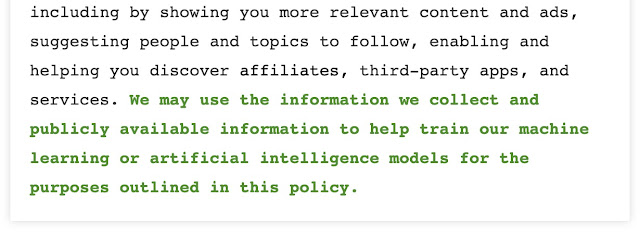
Today’s New York Times features an article that pulls back the curtain on how the AI handover is getting underway, how Google, Meta, X, et a...