Showing posts with label technology. Show all posts

How the Handover Begins

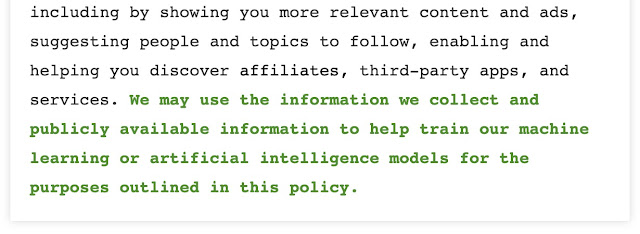
Today’s New York Times features an article that pulls back the curtain on how the AI handover is getting underway, how Google, Meta, X, et al are changing their privacy policies to allow their respective AI models to ingest and use all our activity and information.

Admittedly, I’m on high alert after reading The Handover by David Runciman, a provocative book showing how AI is not the first time we handed our decision-making to machines; it started centuries ago when we built nation-states and corporations, immensely powerful artificial entities with capacities far beyond the that of the individual.

According the Runciman, the handover starts silently and slowly. Which perhaps frames a question we must discuss and solve:  

Is it a good thing to feed AI with the near totality of human thought and behavior? 

Might doing so create a more humanistic entity that serves us, or does it create an entity that makes obsolete human imagination, creativity, and agency?


Are EVs in the dial-up phase?

Several comments on my x-country EV roadtrip travelogues questioned whether the growth in the charging network can possibly keep up with increasing EV sales (a question also posed in this CNBC article).

This is where the lesson from Moore's Law comes in handy: We should expect battery capacity and range to increase exponentially, concurrent with network growth.

There was a time when the internet was shiny and new that we connected to it via dial-up. (If you're old enough, you'll undoubtedly remember the noises your modem made and how loooooooong it took to connect!) Back then we had no clue about the next-gen technologies – connectivity accelerants such as Broadband, Bluetooth, WiFi – that would soon emerge and radically change how we'd access the web.

The point? It's risky to predict the future based on today's technologies and infrastructure.


Fear and loathing in Las Vegas - CES 2020


We live in a world in which culture moves at the speed of technology. Each big advancement – the internet, search, mobile, wifi – has liberated us from what had been holding us back.

CES offers marketers a time to sift through the noise and find the signals pointing to how people are feeling and how behavior may change in the near future.

So how are we feeling? Well, it appears we’re more than a tad mistrustful.

The optimism of tech is being overshadowed by its darker side – an increasingly complex algorithm that divides and perpetuates bias; social platforms that allow falsehoods to pose as truth; screens that foster an aversion to making actual human contact.

We don't need to attend CES to know this. What I did take away from CES is that our mistrust extends beyond tech to the world around us. Ironically, we're turning to tech to protect us from the ills we sense in society.

The home and health categories, in particular, conveyed interesting signals about how people are feeling as seen through the lens of a range of consumer segments and brands.

If I were to write the movie trailer for CES, it might read like this: “In a world that feels dangerous, dirty and difficult, a world in which people no longer trust institutions to solve problems, heroes are taking charge to make their world better.”

Here are three signals I observed:

The world feels dangerous, but my home is my personal fortress.

We've all heard the old saying that "my home is my castle." Tech brands are helping us create crocodile-filled moats around our castles. There are more and more “smart locks”, all following the path paved by Ring, featuring key codes, security cameras that can be accessed on our phone, even fingerprint readers.

Tech is also protecting us from “porch pirates.” The Danby Parcel Guard is package locker for our front door, enabling FedEx to place the package in a box that can only be accessed by the homeowner with a personal security code.

Our anxiety around personal safety extends beyond home intrusion and theft. Climate change is is hitting closer and closer to home, with near constant news footage of flooding, hurricane force winds, and fires. Woodside Homes showcased new houses that can better withstand natural disasters through new building techniques and materials. 

A very real anxiety is increasingly felt by an aging population that is confronting the perils of getting old while living alone at home. AddisonCare is a virtual caregiver that monitors activity in the home, medication intake, reads biometrics to create a “safe-health” home. Welt introduced a smart-belt that can anticipate and help prevent falls among older adults.

The world is polluted and dirty, but my home is my personal clean-room.

Clean-tech was everywhere. In-home air purification was a major theme, ranging from wearable air purifiers to a lamp that purifies air in the home.

BreezoMeter provides personalized, hyper-local air quality assessments to give people information to make better decisions about going outside and reducing exposure to polluted air.

Technology is also rescuing us from the bacteria lurking on the many things we touch throughout the day. HomeSoap is a very stylish box that uses UV-C light to disinfect kids toys, TV remotes, etc. Another of their products, PhoneSoap, is a 10-minute phone charging box that also uses UV-C to disinfect the item we touch most during the day. 

Life feels difficult and time-starved, but the world inside my home is easy.

Most of us have experienced how voice assistants make the complex feel effortless. This same effortless living is being enabled by a wide range of technologies. For example, ViaRoom uses AI to learn behaviors and automate the home environment, including appliances, climate, shades and lights.  

Looking well beyond web-connected kitchen appliances, Samsung is designing kitchen counters with robotic arms to help chop and prep, and also applying AI to help plan meals and monitor nutrition.

Activities that require us to spend time driving somewhere else, e.g., visiting a doctor, can be done on our schedule from home. EyeQue provides vision exams through your smartphone. MedWand enables your doctor to provide physical examinations over the internet.

And in the battle against a stressful world, restorative sleep seems to be our new weapon of choice. Sleep-tech had a huge presence at CES. Philips showed a deep-sleep headband. Sleepace can measure our heart rate, breathing, movement, and ratios of light vs deep sleep to optimize sleep through lighting, smart beds, etc. All of this follows in the footsteps of Sleep Number.

So what should a marketer do?

It has never been more timely for marketers to earn trust from the customers they serve. 

Research has been showing a growing mistrust of many institutions, including government, tech companies, social media and some forms of organized religion. This was on full display at CES. 

But we also saw a way forward. Companies can earn trust through genuine empathy backed by real solutions – human-centered products and services that empower people to take matters into their own hands to create a safer, cleaner and easier world for themselves and the people they care about.

Facebook and Google want to be your TV network.

Facebook CEO Mark Zuckerberg has publicly outlined the company's ambitious Video First strategy, an effort likely to be as big as its previous push into mobile.  At its core, the strategy is designed to make FB our first choice when we want to look at video.

The first steps are already in motion:  Introduced a video-only tab; started promoting longer videos in the news feed; launched a video app for Samsung Smart TVs, Apple TV, Amazon Fire TV; and now will begin paying content creators for high quality, episodic content.

Not to be outdone, Google announced YouTube TV, a $35 monthly "skinny bundle" for cord-cutters, offering 40 channels and content from all four broadcast networks.

But the big news is the availability of live sports, one of the last viewing experiences that keeps many Americans, myself included, tethered by a cable wire.   But YouTube TV will include some regional sports from ESPN.

It's important to monitor the success and growth of each.  It's also important for marketers to think "video" and not "TV."  They sound the same, but they are not.


Virtual Assistants a growing reality.

Alexa, mark my words, literally.  Voice Assistants will set new expectations for how customers want to interact with brands, hardware, shopping sites and apps.

Then again, I saw this coming back in 2013 when I coined the expression #HandsFreeWeb in describing the future of web-enabled houses!

Now that Apple has announced HomePod, we will likely see an epic battle with Amazon Echo and Google Home for leadership in interactive voice.

Amazon Echo has become a surprise hit, putting Amazon well ahead of Google to lead the race toward applying natural human language to search and perform tasks.  In a race to catch up, Google Home also uses AI to understand what users are saying and respond conversationally.

Going forward, I can see a day when typing into a keyboard, whether a phone, tablet or PC, will be viewed as time consuming and old fashioned.


What we're doing online.

Great infographic.  It is mind-blowing to see the change in our online behaviors and growth of new platforms in just three years.

source: BusinessInsider.com

Google's take on the future.

I met with the team from Google today and continue to respect the ideas that come out of the Googleplex.  Yes, they're always right on the verge of Big Brother type stuff.  But the stuff they do helps organize our lives and enable us to do more (consistent with their mission!).  Since the future of Google is increasingly the future of us, this is worth watching.


Happy Birthday, Moore's Law.

Today is the 50th anniversary of Moore's Law.  And I'm typing this on a tiny device that is smaller, more powerful and less expensive than any of its predecessors, yet will be larger, less powerful and more expensive than the device I will likely be using in two years time.  

I became enamored with the power and clarity of Moore's Law when I worked with Applied Materials to help market the world changing merits of nanotech. Moore's Law is one of the primary reasons why we live in awesome times, and why business is increasingly more productive. 

Thank you Gordon Moore.

What's the state of relationships in a digital age?

As humans, we need to be safe; we want to belong; we yearn to be loved; and, most of all, we hope that we matter – to our friends, to our families, within our communities, and to the companies with which we do business.  Relationships help satisfy these basic needs.  That’s why we seek them. That’s why we need them. 


A few weeks ago I had the opportunity to give the keynote address at the annual JD Power Automotive Marketing Roundtable in Las Vegas and pose this question to the audience: What is the state of human relationships in the digital age?  This isn’t an abstract question. As marketers, we have no choice but to confront and resolve this question.  (Click here to see the speech.)

I’ve come to embrace a simple truth about marketing – what’s true in real life should be true in marketing.   Listen to our vocabulary:  Brand relationships; Customer relationships; CRM.  If our goal truly is to build customer relationships, then we should dig deeper to better understand how people form real, personal relationships. 

As marketing becomes increasingly driven by data and technology, we must re-learn how to forge more personal, more authentic customer relationships.  In a digitally-driven world, the 4Es of personal relationships—empathy, experiences, endorsement and energy—gives marketers a clear framework for creating relevant and lasting customer relationships. 

After all, to connect with customers that increasingly prize authenticity in companies and brands, it pays to remember that what is true in life should be true in marketing.


How the Handover Begins

Today’s New York Times features an article that pulls back the curtain on how the AI handover is getting underway, how Google, Meta, X, et a...