Showing posts with label innovation. Show all posts

Are EVs in the dial-up phase?

Several comments on my x-country EV roadtrip travelogues questioned whether the growth in the charging network can possibly keep up with increasing EV sales (a question also posed in this CNBC article).

This is where the lesson from Moore's Law comes in handy: We should expect battery capacity and range to increase exponentially, concurrent with network growth.

There was a time when the internet was shiny and new that we connected to it via dial-up. (If you're old enough, you'll undoubtedly remember the noises your modem made and how loooooooong it took to connect!) Back then we had no clue about the next-gen technologies – connectivity accelerants such as Broadband, Bluetooth, WiFi – that would soon emerge and radically change how we'd access the web.

The point? It's risky to predict the future based on today's technologies and infrastructure.


Dare to be wrong!


-->
Those who work with me know one of my favorite exhortations:  Dare to be wrong!  Take more chances; be more curious; be the catalyst that helps the team find a better idea. Waiting for the perfect solution is a sure-fire way to become road kill. 

But my exhortation flies into the headwinds of a culture that prizes perfection.   Management gurus exhort us to pursue excellence, to move from good to great.  Even social media demands that we always project the most perfect version of our lives.

My goal for the upcoming year is to spend more time celebrating “better” instead of “perfect.”

I thought about this recently after speaking to a group of college students who are considering a career in marketing communications.  One student sent me a follow up note asking this question: “Has there ever been a time where you had to execute a project that didn’t turn out as successful as you had imagined? If so, how were you able to bounce back from that?”

Packed deep within her question was the assumption that in business, let alone in life, we are expected to succeed every time and that failure is, well, a failure.  My response was simple: you will likely fail more than you will succeed, and that this is part of the process of gaining knowledge and experience, each project, each day, each year.

Getting better is a noble pursuit.  Life is a journey of learning.  So, too, is business.

Practitioners of Design Thinking embrace the principle of rapid prototyping over waiting to build a perfect representation of an idea.  (Microsoft’s CEO Satya Nadella is working to shift his company’s culture from one of know-it-all to one that values learn-it-all.)

It’s not innovation that sets Silicon Valley apart from other centers of technological development—it’s a willingness to iterate toward an ever better idea.

Sony and Toyota, two marketers I’ve had the good fortune to work with, are dedicated to the Japanese philosophy of Kaizen, which means to “change for the better.”

Digital marketing teams everywhere pursue optimization, which if you think about, is simply Kaizen – learning how to continuously improve the outcomes of our work, then do so again tomorrow and the day after that as well. 

Colin Powell, a retired four-star general and secretary of state, has a rule of thumb about making tough decisions. Every time you face a tough decision you should have no less than 40% and no more than 70% of the information you need.  If you move forward with less than 40% of the information, you’re shooting from the hip.  If you wait until you have 70% of the information, the opportunity will likely pass.  (Increasingly true as markets, customer behaviors, and competitors are changing faster than ever.)

Too many times I see people in meetings who I know have a point of view, yet are afraid to offer it up because they’re not certain their idea is right.  I’ve learned over time that ideas are usually born out of a collision between two seemingly opposing or disparate ideas.  In daring to be wrong – daring to offer up your idea – you serve as a catalyst to help others uncover an even bigger idea as they challenge and build upon your point of view.

So, here’s to 2022.  It doesn’t have to be the best year ever, just a better year.  One in which we celebrate continuous learning and growth.  One in which we dare to be wrong.

"Remember when"...I could have been a billionaire.

In April, 2011 Facebook launched Timeline to enable us to chronologically categorize photos and events.

In September, 2008 I scribbled this idea in an old journal that I recently stumbled upon:  Create a website called "Remember When" – a chronological scrapbook of the moments in your life.  

Yes, I had invented Timeline nearly three years before Facebook.  No, I did not do anything with the idea beyond writing it down in an apparent plot to torment my future self.

At the time I was inspired by the insight that many of us have a running stream of memories and events that are sometimes fuzzy on dates and details.  Was it in 5th grade or 6th that I took that camping trip with my childhood friend Mike Harris?  Was that memorable guys reunion trip to Vegas (that we really should not remember) in 2002 or 2003?  In what year did I spar with Muhammad Ali on the back of that plane?  Was the drunken Barney the Dinosaur at Lauren's 4th or 5th birthday party?

The idea was based on a wizard that would prompt and post memories along a timeline so that over time you could see the story arc of your life.  It would include multiple views into your life's chronology – through events or photos or pop culture milestones.

I also wrote about a community of friends posting recollections of shared memories, with an ability to overlay a friend's timeline on your own (what were you doing when I was doing...).  What kills me most is this next notation:  include a way to alert friends when you post a memory that includes them.  
So the moral of the story is this:  If you can dream it you can do it.  And if you do it...secure the legal rights before Mark Zuckerberg does. 


Fear and loathing in Las Vegas - CES 2020


We live in a world in which culture moves at the speed of technology. Each big advancement – the internet, search, mobile, wifi – has liberated us from what had been holding us back.

CES offers marketers a time to sift through the noise and find the signals pointing to how people are feeling and how behavior may change in the near future.

So how are we feeling? Well, it appears we’re more than a tad mistrustful.

The optimism of tech is being overshadowed by its darker side – an increasingly complex algorithm that divides and perpetuates bias; social platforms that allow falsehoods to pose as truth; screens that foster an aversion to making actual human contact.

We don't need to attend CES to know this. What I did take away from CES is that our mistrust extends beyond tech to the world around us. Ironically, we're turning to tech to protect us from the ills we sense in society.

The home and health categories, in particular, conveyed interesting signals about how people are feeling as seen through the lens of a range of consumer segments and brands.

If I were to write the movie trailer for CES, it might read like this: “In a world that feels dangerous, dirty and difficult, a world in which people no longer trust institutions to solve problems, heroes are taking charge to make their world better.”

Here are three signals I observed:

The world feels dangerous, but my home is my personal fortress.

We've all heard the old saying that "my home is my castle." Tech brands are helping us create crocodile-filled moats around our castles. There are more and more “smart locks”, all following the path paved by Ring, featuring key codes, security cameras that can be accessed on our phone, even fingerprint readers.

Tech is also protecting us from “porch pirates.” The Danby Parcel Guard is package locker for our front door, enabling FedEx to place the package in a box that can only be accessed by the homeowner with a personal security code.

Our anxiety around personal safety extends beyond home intrusion and theft. Climate change is is hitting closer and closer to home, with near constant news footage of flooding, hurricane force winds, and fires. Woodside Homes showcased new houses that can better withstand natural disasters through new building techniques and materials. 

A very real anxiety is increasingly felt by an aging population that is confronting the perils of getting old while living alone at home. AddisonCare is a virtual caregiver that monitors activity in the home, medication intake, reads biometrics to create a “safe-health” home. Welt introduced a smart-belt that can anticipate and help prevent falls among older adults.

The world is polluted and dirty, but my home is my personal clean-room.

Clean-tech was everywhere. In-home air purification was a major theme, ranging from wearable air purifiers to a lamp that purifies air in the home.

BreezoMeter provides personalized, hyper-local air quality assessments to give people information to make better decisions about going outside and reducing exposure to polluted air.

Technology is also rescuing us from the bacteria lurking on the many things we touch throughout the day. HomeSoap is a very stylish box that uses UV-C light to disinfect kids toys, TV remotes, etc. Another of their products, PhoneSoap, is a 10-minute phone charging box that also uses UV-C to disinfect the item we touch most during the day. 

Life feels difficult and time-starved, but the world inside my home is easy.

Most of us have experienced how voice assistants make the complex feel effortless. This same effortless living is being enabled by a wide range of technologies. For example, ViaRoom uses AI to learn behaviors and automate the home environment, including appliances, climate, shades and lights.  

Looking well beyond web-connected kitchen appliances, Samsung is designing kitchen counters with robotic arms to help chop and prep, and also applying AI to help plan meals and monitor nutrition.

Activities that require us to spend time driving somewhere else, e.g., visiting a doctor, can be done on our schedule from home. EyeQue provides vision exams through your smartphone. MedWand enables your doctor to provide physical examinations over the internet.

And in the battle against a stressful world, restorative sleep seems to be our new weapon of choice. Sleep-tech had a huge presence at CES. Philips showed a deep-sleep headband. Sleepace can measure our heart rate, breathing, movement, and ratios of light vs deep sleep to optimize sleep through lighting, smart beds, etc. All of this follows in the footsteps of Sleep Number.

So what should a marketer do?

It has never been more timely for marketers to earn trust from the customers they serve. 

Research has been showing a growing mistrust of many institutions, including government, tech companies, social media and some forms of organized religion. This was on full display at CES. 

But we also saw a way forward. Companies can earn trust through genuine empathy backed by real solutions – human-centered products and services that empower people to take matters into their own hands to create a safer, cleaner and easier world for themselves and the people they care about.

How the Handover Begins

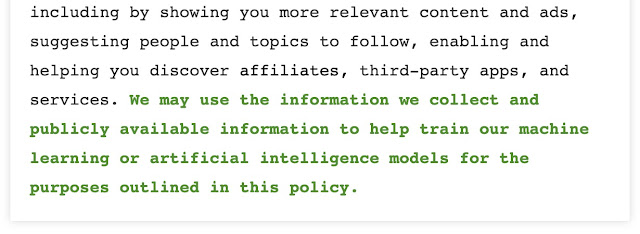
Today’s New York Times features an article that pulls back the curtain on how the AI handover is getting underway, how Google, Meta, X, et a...