Showing posts with label university lectures. Show all posts

What Marketers Can Learn from "The Big Short."

The Big Short is more than a story about the 2007 mortgage crisis - it’s a cautionary tale about the peril of not understanding the human context behind data.  


Mark Baum, the investor played by Steve Carell, had his team gather first-hand insights to uncover what the raw data was hiding from others. They went out and talked to people on the front lines — the shady mortgage brokers; the compromised ratings agencies; the “nightclub” worker who owned five homes; the father who had dutifully paid his bill yet was about to lose his home — before deciding to short the Collateralized Debt Obligations that would soon turn toxic.  They invested the time to understand the human context — behaviors, motivations, beliefs.


What purely data-derived assumptions do we have about customers.  Do we understand how they feel and why they do what they do? 


This is the question I’ll be posing to students as I share the Rehumanize platform during my upcoming university lectures at California State-Fullerton, Loyola Marymount University, and the University of California-Irvine’s Merage School of Business. 


With empathy at its core, Rehumanize is a brand growth system modeled on the four dynamics of human relationships. Its “4Es” framework connects insights, goals, tactics, data and enterprise-wide collaboration to form a human-centered growth strategy.

Let's rehumanize marketing!


Every new marketing model seems to move farther from a fundamental truth – there’s a human on the other side of the screen.

We can sense this growing chasm in marketing's increasingly de-humanized vocabulary – addressable markets, cohorts, targets, segments; we can sense it in blunt, one-size-fits-all multicultural definitions and generational tags.

Despite being awash in data and analytics that tell us what customers did, most companies don’t fully understand why their customers behave the way they do.   


A Harvard Business Review Analytical Services study found that just 23% of executives believe their organization understands their customers’ motivations. (Even if this has doubled since 2019 that's still not great.)

Customer Experience, or CX, comes closest to embracing a human-centered truth. Yet here we are in 2023 and CX remains siloed in many organizations. 

Being human-centered is not about going analog. Far from it! Data and marketing technologies have given us superpowers in our ability to be more relevant and personalized.


This is about shifting our mindset – making empathy a core skill; designing more human-centered ways to organize teams; truly understanding what it means to have a relationship with a customer.

Being Human: 101

In my recent university lectures, I speak to students about human behavior and the power of empathy. With a clear nod to Abraham Maslow, here’s how I summarize for them our basic human motivations:

We create relationships as a way to help satisfy these needs, and the strongest begin are sustained through empathy – the ability to see through the eyes of another, without judgement. Empathy helps form meaningful relationships because it builds trust.

If this is true in life, why isn’t this consistently true in marketing?

Prioritizing the “R” in CRM

Several years ago I realized the mistake I had long been making.

While giving a presentation I noticed I was repeating the word relationship on slide after power-pointy slide, e.g., customer relationship, brand relationship, CRM. I hadn't yet invested time to unpack this simple word to understand the dynamics of real relationships.

That “ah-ha moment” helped crystalize a simple truth: what’s true in life should be true in marketing – how we form personal relationships should guide how we form customer relationships.

And that truth ultimately inspired Rehumanize, a marketing consultancy that helps organizations and people grow by harnessing the power of empathy and human relationships.


Rehumanize organizes goals, metrics, and teams around the four dynamics of human relationships – empathy, experiences, endorsement, and energy – aka, "The 4Es."


Connecting the Dots

Rehumanize's 4E Loyalty Model represents System Thinking – i.e., a way to make sense of complexity by viewing a problem in terms of wholes and relationships rather than its parts. In this case, the "whole" is the dynamics of human relationships.

This is what differentiates the 4E model from CX and CRM. Unlike those strategies, 4E integrates the contributions of other disciplines such as media communications, social media, event marketing, influencer strategies, product development, etc.

4E connects the dots across the enterprise – the benefit of systems thinking – to create a human-centered model to organize and analyze data, plan and prioritize strategies, and foster collaboration across teams.

Designing a human-centered organization sounds daunting, yet the necessary data, resources and skills likely already exist in your company but are disconnected from each other.

The 4E Loyalty Model is underpinned by the metrics we use every day, but live in different organizational silos, scattered across disparate reports, discussed in separate meetings.


When seen through the 4Es, these metrics realign to paint a clear picture of the opportunities, progress, and work to be done.


Teams in Marketing, Behavioral Analytics, UX/CX, Customer Care, Product and Corporate Comms all contribute. 4E creates a common vocabulary, shared planning model, and aligned KPIs.


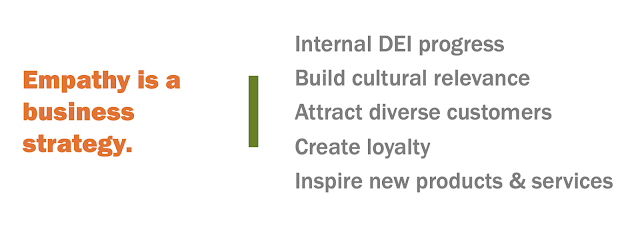
Empathy is a business strategy

Empathy may sound soft, but 4E is a measurable, outcome-oriented system that align goals, analytics and action.

Empathy helps accelerate progress on DEI initiatives; it can build authentic cultural relevance and growth among diverse customers; it can strengthen the effectiveness of a company’s CRM investments; it helps inspire new product development.

Spiderman and Maya Angelou agree.

While it’s true that Big Data and Martech have given us marketing superpowers, it’s also true that “with great power comes great responsibility” (as Uncle Ben advised Peter Parker, aka Spiderman).

Our responsibility is to use human insights, data and technology to better serve customers – to help organizations and people grow by harnessing the power of empathy and human relationships.

Marketing leaders have always had to hold in their mind two seemingly contradictory ideas: Marketing is about customer empathy; marketing is about profitable growth.

Each statement is true. Each is less effective without the other.


And here, I step aside and let Maya Angelou summarize my 29 paragraphs in 22 words.


Job vs a Profession.

So happy today to be able to spend time with GTB's STRIVE team and talk with young professionals about ways to create a rewarding career in advertising. We discussed the difference between a job and a profession. When viewed as a profession, you commit to being in the business of building brands (not tactics); view your career as a journey of learning; know there is no substitute for hard work and preparation; and always have a POV. Above all, you dare to be wrong!

Why I love working in advertising.

I love working in advertising.

We help companies care about their customers' hopes and dreams.  We help companies grow.  We get to collaborate with smart, funny, talented people with diverse backgrounds and interests.

Several times a year I serve as a guest lecturer at University of California, Irvine and Chapman University.  I enjoy mentoring the next generation of advertising professionals.  They remind me how lucky I am.  When I look out across the classroom, I see in their eyes that they would walk across hot coals to be doing what I do.

I always begin my talks with my profession of love and appreciation for my career in advertising, for being able to spend my days at the intersection of business and everything imaginable.  A day in advertising is a day spent absorbing market dynamics; social trends; new technologies; design; emerging media platforms; pop culture influences.  It's a business of ideas – ideas born of hard work, knowledge and serendipity.

True, it can be a day and night job.  And it can be emotionally draining and stressful.  But, again, we get to work in a business of ideas.  That doesn't suck.

I recently spoke to a group of University of Michigan students who asked me to share my advice as they embark on their careers.  Here's what I told them:

  1. Pursue a profession, not a job.  Whatever you decide to do, be the consummate professional. Accumulate skills and knowledge.  Be great at a few things and not simply average at many things. 
  2. Be curious.  Embrace your career as a journey of learning.  You need not know everything.  But you need to ask more interesting questions of those who do know.  Questions provoke ideas and progress.
  3. Fail.  Learn.  Repeat.  (Need I say more?)
  4. Be accountable.  Blaming others is not only is a waste of time, it's a wasted opportunity to learn and grow.  Victimhood serves no purpose.  
  5. Be dependable.  We value people who do what they say they're going to do.  (True in life, true in business.)  Demonstrate early on in your career your ability to get things done.  
  6. Solve problems.  Don't whine about problems.  It's what we're paid to do.  The sales graph pointing downwards is a problem.  Unhappy franchisees is a problem.  High bounce rates on a website is a problem.  Negative brand perceptions are a problem.  We fix problems. 
  7. Have a voice.  Meetings aren't a spectator sport.  Have the courage to show you are a thinking individual.  Always have a point of view.  Don't worry about whether your perspective is right or wrong.  Expressing your idea will be a catalyst for others to challenge or build upon it.  And this is how ideas are born, from the collision of diverse perspectives.
  8. Reimagine yourself, often.  Don't allow yourself to grow stale.  Enroll in the training your company offers.  Accept opportunities that force you to learn.  Creative people must continually evolve.  Years ago I had the good fortune to attend a talk given by George Martin, the legendary producer of the Beatles.  This was his lasting lesson from the Beatles – they experimented and took risks and, by doing so, avoided a repetitious formula.
  9. Always ask "why" and "why not."  These two seemingly simple questions pack tremendous power.  Why challenges the status quo while also signaling curiosity.  Why not is the eternal anthem of optimists.  It's hard to go wrong navigating by these two questions.
  10. Learn to be a commercial anthropologist.  I believe this is central to succeeding in advertising.  Your anthropologist side requires a fascination with people and the strength to observe without judgement.   The commercial side is a constant reminder that advertising exists to help companies sell.  Keep both sides in equal balance.  Too much human observation without bottom line impact isn't good.  Too much selling devoid of human insights creates a commodity business. 
My parting advice to these students is always the same:  I don't care what you end up doing.  But thirty years from now, make sure you can stand up and say "I love what I do for a living."  

How to love what you do.

Three decades into my career I am happy to proclaim that I love what I do for a living.  Each time I lecture at Chapman University or UC Irvine, I always start by telling this to the students and sharing my hope that, regardless of what they end up doing, that they too will stand up some day and proclaim this.  Life's too short to waste time on things you don't enjoy doing.

Clearly, the first step is to know what you're passionate about and then find someone who will pay you to do that.  But then what?  How do you stay engaged and passionate for three decades or more?  Here's the advice I tend to share with the students.

Pursue a profession, not a job.  You can punch in and out each day, doing what's required and no more.    Or you can be constantly curious, always pushing yourself to learn more and develop new skills.  Not to get ahead, but for the satisfaction of knowing you are the best you can be at what you do.

Be great at something.  Sure, you work in a department and you have many responsibilities and functional duties.  But what are you the best at?  What is that one skill that you are known for and that your coworkers depend on?

Accumulate skills.  Attend as many training programs as your company offers.  Volunteer to work on project teams that are outside of your day to day responsibilities.  Listen to a TED talk on issues related to your field.  Read.  Discuss.

Fail. Improve. Repeat often.  There's an old saying that it takes a lot of hard work to get lucky.  Successful people are simply those who took the time to learn from their mistakes.  And those who willing to learn from mistakes also tend to be the same people who are more open to taking chances.  Courage and humility often go hand in hand.


Liberating marketing from old vocabulary.

In my recent talk to the students at Chapman University's Internet Communications Program, I exhorted this next generation of marketing ninjas to help liberate marketing from the antiquated vocabulary that fosters silos in how we think and act:
  • We must reject tired distinctions such as "traditional vs non-traditional" marketing.  (There is only traditional thinking...and this is punishable by irrelevance!)
  • We must admit that terms such as "new media" represent old thinking.  (If you want to make anyone under 25 laugh, refer to mobile as "new media.")
  • We must not allow "offline and online" to live in separate silos.  (In a world of QR codes and second screen viewing, is anything truly "offline"?)
  • We cannot restrict "brand advertising" to mean TV and print.  (The Internet is the most powerful branding tool ever.  Storytelling.  Sight, sound, motion.  Peer endorsement.  Experiences.)
  • We must embrace media as a source of creativity.  (How and where a brand appears is as important as what it says.)
  • We need to enthusiastically embrace metrics, both hard and soft.  (Ignore store traffic and nobody will care about the awareness gain.  Similarly, click through rates at the expense of emotional relevance and differentiation will not matter if the brand degrades to commodity status.)
Finally, we must break with the past.  Old branding models are out of step with the way in which people consume media and interact with brands.  Instead, new models such as Empathic Marketing build brand relationships by mirroring the ways in which people tend to form real, human relationships.  These 4Es of real relationships –  empathy, experiences, energy and endorsement – form a clear and measurable brand planning model to help marketers create more customer-centered brand platforms.  After all, what's true in life is true in marketing.

How the Handover Begins

Today’s New York Times features an article that pulls back the curtain on how the AI handover is getting underway, how Google, Meta, X, et a...