Showing posts with label consumer behavior. Show all posts

What is your brand's "Fast Car?"


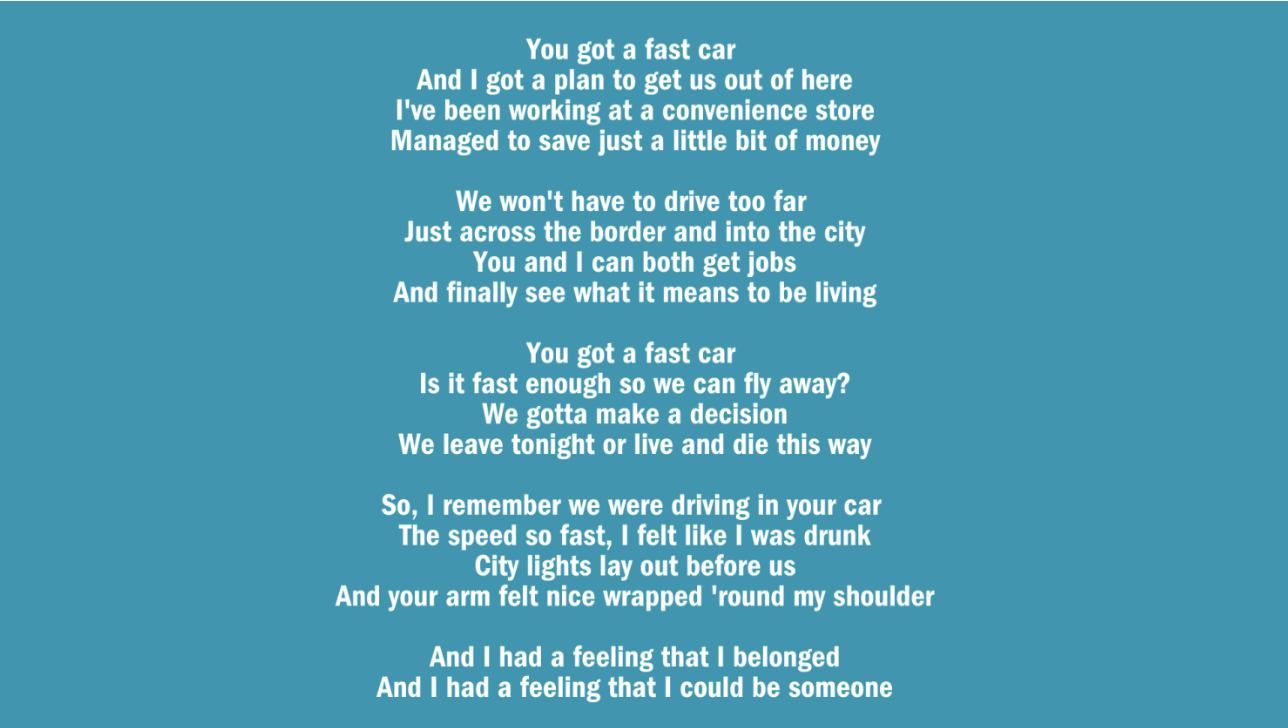
If you watched the Grammy Awards last Sunday, you saw an audience moved by Tracy Chapman and Luke Combs performing a duet of "Fast Car." Or dial up the YouTube and watch her 1988 performance at Wembley Stadium where the unknown artist was asked to fill time when Stevie Wonder's set was delayed by a technical malfunction, and watch that song quiet a massive and restless crowd.

Why? Because "Fast Car" touches the marrow of our universal human experiences and needs. It's an example of the power of truly understanding people, and the risk of not.

Recently, pundits and politicians have been scratching their heads, puzzled why people don't agree with the data that shows the strength and resilience of the economy. To me, this is just another example of not seeing the people behind the data (in this case, the daily reality of working-class people and towns that Tracy Chapman wrote about).

Empathy is a powerful tool for marketers to better understand people. There are many research methodologies we can use to understand human context by exploring attitudes, values, and mindsets.


There is also the unparalleled value of first-hand observation — venturing into the customer’s world, standing in their shoes, seeing life through their eyes to find authentic ways to demonstrate how your brand sees and hears them. (When I worked with Ford at WPP, I admired the commitment of the Ford Truck team to spend time at rodeos, races, job sites talking with people, getting to know them and their needs. It is little surprise that the F-150 is America’s top selling vehicle.)

Each time I teach the Rehumanize brand growth system at UC Irvine and Loyola Marymount, or in workshops at companies such as Genesis Bank or Bastion, one of my first declarations is that empathy is a squishy sounding growth strategy — a way to form tighter bonds with loyal customers; inspire new products and services; understand an increasingly diverse marketplace.

Which brings me back to Tracy Chapman’s song.  Is your brand strategy grounded in an honest and empathetic insight? Can you describe your customer's world as intimately as you could that of your oldest friend? Does it tap into their hopes while also understanding the barriers they confront?

What is your brand's "Fast Car"?

What Marketers Can Learn from "The Big Short."

The Big Short is more than a story about the 2007 mortgage crisis - it’s a cautionary tale about the peril of not understanding the human context behind data.  


Mark Baum, the investor played by Steve Carell, had his team gather first-hand insights to uncover what the raw data was hiding from others. They went out and talked to people on the front lines — the shady mortgage brokers; the compromised ratings agencies; the “nightclub” worker who owned five homes; the father who had dutifully paid his bill yet was about to lose his home — before deciding to short the Collateralized Debt Obligations that would soon turn toxic.  They invested the time to understand the human context — behaviors, motivations, beliefs.


What purely data-derived assumptions do we have about customers.  Do we understand how they feel and why they do what they do? 


This is the question I’ll be posing to students as I share the Rehumanize platform during my upcoming university lectures at California State-Fullerton, Loyola Marymount University, and the University of California-Irvine’s Merage School of Business. 


With empathy at its core, Rehumanize is a brand growth system modeled on the four dynamics of human relationships. Its “4Es” framework connects insights, goals, tactics, data and enterprise-wide collaboration to form a human-centered growth strategy.

Let's rehumanize marketing!


Every new marketing model seems to move farther from a fundamental truth – there’s a human on the other side of the screen.

We can sense this growing chasm in marketing's increasingly de-humanized vocabulary – addressable markets, cohorts, targets, segments; we can sense it in blunt, one-size-fits-all multicultural definitions and generational tags.

Despite being awash in data and analytics that tell us what customers did, most companies don’t fully understand why their customers behave the way they do.   


A Harvard Business Review Analytical Services study found that just 23% of executives believe their organization understands their customers’ motivations. (Even if this has doubled since 2019 that's still not great.)

Customer Experience, or CX, comes closest to embracing a human-centered truth. Yet here we are in 2023 and CX remains siloed in many organizations. 

Being human-centered is not about going analog. Far from it! Data and marketing technologies have given us superpowers in our ability to be more relevant and personalized.


This is about shifting our mindset – making empathy a core skill; designing more human-centered ways to organize teams; truly understanding what it means to have a relationship with a customer.

Being Human: 101

In my recent university lectures, I speak to students about human behavior and the power of empathy. With a clear nod to Abraham Maslow, here’s how I summarize for them our basic human motivations:

We create relationships as a way to help satisfy these needs, and the strongest begin are sustained through empathy – the ability to see through the eyes of another, without judgement. Empathy helps form meaningful relationships because it builds trust.

If this is true in life, why isn’t this consistently true in marketing?

Prioritizing the “R” in CRM

Several years ago I realized the mistake I had long been making.

While giving a presentation I noticed I was repeating the word relationship on slide after power-pointy slide, e.g., customer relationship, brand relationship, CRM. I hadn't yet invested time to unpack this simple word to understand the dynamics of real relationships.

That “ah-ha moment” helped crystalize a simple truth: what’s true in life should be true in marketing – how we form personal relationships should guide how we form customer relationships.

And that truth ultimately inspired Rehumanize, a marketing consultancy that helps organizations and people grow by harnessing the power of empathy and human relationships.


Rehumanize organizes goals, metrics, and teams around the four dynamics of human relationships – empathy, experiences, endorsement, and energy – aka, "The 4Es."


Connecting the Dots

Rehumanize's 4E Loyalty Model represents System Thinking – i.e., a way to make sense of complexity by viewing a problem in terms of wholes and relationships rather than its parts. In this case, the "whole" is the dynamics of human relationships.

This is what differentiates the 4E model from CX and CRM. Unlike those strategies, 4E integrates the contributions of other disciplines such as media communications, social media, event marketing, influencer strategies, product development, etc.

4E connects the dots across the enterprise – the benefit of systems thinking – to create a human-centered model to organize and analyze data, plan and prioritize strategies, and foster collaboration across teams.

Designing a human-centered organization sounds daunting, yet the necessary data, resources and skills likely already exist in your company but are disconnected from each other.

The 4E Loyalty Model is underpinned by the metrics we use every day, but live in different organizational silos, scattered across disparate reports, discussed in separate meetings.


When seen through the 4Es, these metrics realign to paint a clear picture of the opportunities, progress, and work to be done.


Teams in Marketing, Behavioral Analytics, UX/CX, Customer Care, Product and Corporate Comms all contribute. 4E creates a common vocabulary, shared planning model, and aligned KPIs.


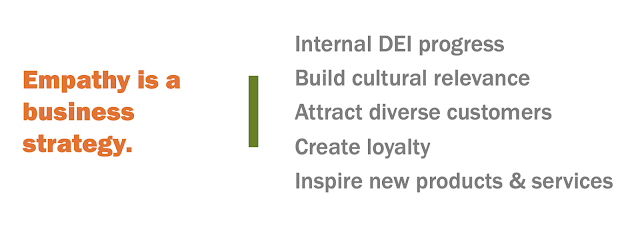
Empathy is a business strategy

Empathy may sound soft, but 4E is a measurable, outcome-oriented system that align goals, analytics and action.

Empathy helps accelerate progress on DEI initiatives; it can build authentic cultural relevance and growth among diverse customers; it can strengthen the effectiveness of a company’s CRM investments; it helps inspire new product development.

Spiderman and Maya Angelou agree.

While it’s true that Big Data and Martech have given us marketing superpowers, it’s also true that “with great power comes great responsibility” (as Uncle Ben advised Peter Parker, aka Spiderman).

Our responsibility is to use human insights, data and technology to better serve customers – to help organizations and people grow by harnessing the power of empathy and human relationships.

Marketing leaders have always had to hold in their mind two seemingly contradictory ideas: Marketing is about customer empathy; marketing is about profitable growth.

Each statement is true. Each is less effective without the other.


And here, I step aside and let Maya Angelou summarize my 29 paragraphs in 22 words.


We are the supply chain problem.


We can’t go a day without hearing, or sharing our own story, about a seemingly simple purchase that is taking eons to arrive, an impatience that has heightened in a next-day culture.

In casual conversations we hear people cite the cause as having something to do with lazy workers, politicians, Russia’s aggression in Ukraine, or myriad other heard-then-repeated explanations.

Turns out, we are the problem: Our business models, our disconnected systems, our labor practices, our personal shopping choices. We are the forces straining the system.

That’s why this WSJ video is so fascinating. It starts with the sobering truth, that global demand is greater than what supply chains can handle. From there it unpacks the thorny thicket of disconnected problems raging through the system – i.e., through factories, ocean shipping, ports, trucking, and distribution centers – all made worse by rapid changes in DTC business models and the resulting shift in consumer shopping behavior.

And, spoiler alert, this story might not have a happy ending. Our supply chains may be forever strained without a massive rethink of how we solve – and connect– the problems.

For those of us who don't have time to binge a 54 minute video, here are some key highlights:

Supply Chains scaled down when Covid hit (e.g., capacity, inventories, labor, etc), expecting that global consumer demand would contract.  It didn’t. 

Shipping ports are a fragile point of failure.  Our ports, most notably the Port of Long Beach here in the US), represent a singular intersection of the problems spanning ocean shipping, trucking, labor and consumer demand. 

We don’t have enough truckers in the US.  Nearly 10M people have a CDL license yet only 3.5M are driving. Why? They are poorly paid (new drivers barely earn minimum wage), are seldom home, and work 14+ hour days. 

Seismic changes in consumer behavior, acclerated by eCommerce and DTC models, are further straining supply chains, which must now deliver more products to specific addresses instead of mass deliveries to fewer big box stores. And as we know, more and more consumers embraced online shopping during the pandemic 

Distribution centers experience high employee burn-out. People working at these fast-paced, always-on distribution centers experience work-related injuries at a rate that’s nearly double coal mining, construction, and most manufacturing industries. (Turnover at many of Amazon’s distribution centers exceeds 100%.) 

We have a shortage of last-mile delivery drivers.  These are the drivers that more often than not are working for delivery partners subcontracted by Amazon and others. (This is why Amazon started its own package delivery company, which will in time be the largest parcel delivery company in the US.)

Navigating the Consumer "Pleasure Revenge"​ – advice from Mark Twain, a Surfer and a Futurist Named Popcorn.


The post-pandemic "Pleasure Revenge" is accelerating consumer spending and a return to pre-Covid behaviors.

As the Wall Street Journal recently reported, Americans are returning to gyms in big numbers; booking vacations and plane trips; rocking out at concerts; and going to popcorn-scented movie theaters to see Hollywood blockbusters such as Spider-Man.

What the WSJ missed is that we see this same human behavior after every major shock to the national psyche, as well as the inevitable post-exuberance counter-trend...which brings us to Mark Twain, Faith Popcorn and Laird Hamilton.


"History doesn't repeat itself, but it often rhymes."


Mark Twain told us this would happen.

The national and personal sacrifice endured during WWI was followed by the Roaring Twenties. After WWII, the U.S. economy boomed as Americans bought homes, moved to the suburbs, drove the latest tail-finned beauty from Detroit, and had many, many kids. The economic malaise of the '70s ushered in the 1980s and "Beemer"-driving Yuppies with a voracious appetite for wine, martinis and cigars. And following the severe emotional and economic pain inflicted on 9/11, per capita consumer spending began to steadily climb.

"For every trend, there is a counter-trend."


This "Pleasure Revenge" – popularized by trend expert, Faith Popcorn – taps into a deep human need to soothe pain and maybe even re-exert control over our lives after having had our "normalcy" abruptly taken from us.

But as important as it for businesses to have strategies to profit during the post-crisis Pleasure Revenge, Ms. Popcorn cautions us to think beyond that exuberant period and prepare for the counter-trend, a theme she frequently cites.

What might a counter-trend look like a few years from now? Well, consider that each of those boom periods mentioned above eventually led to an equally large counter-force.

The Roaring Twenties was followed by the Great Depression. The insatiable consumerism of the 1950s and early 60s preceded the economic stagnation of the 1970s. In 1989, Yuppies woke up to Black Monday – their first global economic crisis. The post 9/11 economic growth abruptly crashed in 2008 because of the subprime lending meltdown.

Which brings us to surfing.


"Surfing's one of the few sports that you look ahead to see what's behind."

So what should businesses do? Well, perhaps take inspiration from surfing legend Laird Hamilton. Like a riding a heavy wave, get too far ahead of it and it will crush you; drop in too late and end up nowhere. Timing is everything.

Businesses must invest in products and experiences that satisfy the current unbridled demand and consumer spending.

But as Laird Hamilton advises, be aware of what's following from behind – a big counter trend that may lead to an eventual economic downturn. Best to not invest and expand with a mindset that this frothy consumer spending will never end. It will.

Just ask Mark Twain.

How the Handover Begins

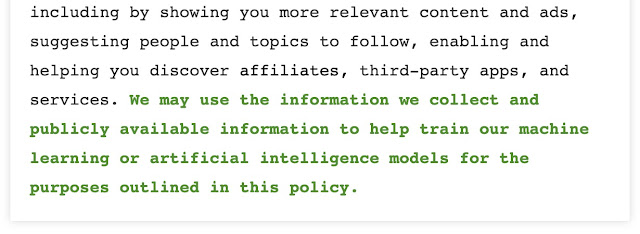
Today’s New York Times features an article that pulls back the curtain on how the AI handover is getting underway, how Google, Meta, X, et a...