This piece from HBR corroborates they key themes I've advocated in my 4Es branding model.
HBR calls into question the commonly accepted belief that customers want relationships with brands. They don't. It goes on to point out that what customers seek is a sense of shared values.
That's why I've embraced a brand planning model based on the power of empathy.
As I've written previously, I believe that the way in which we form brand relationships mirrors how we form personal relationships. Forces such as empathy, experiences, energy and endorsement help form our real life relationships.
Empathy tends to be the basis of our strongest and lasting personal relationships. We connect with people who share our values, sense of style, even our sense of humor. This holds true with brands. Brand empathy occurs when customers project onto your brand their own attitudes and values.
Like people, brands are judged by what they do, not just by what they say. We tend to believe something after we've experienced it first hand. In marketing, well orchestrated brand experiences help turn perceptions into beliefs when customers sense a brands words and actions are in sync.
Nostradamus and social media

This may or not be true. I don't know. I'm not sure even the great 16th Century seer could give us guidance.
However, I do believe that the way in which we'll use this medium in the future will be very different than how we're using it today. It will evolve in ways we cannot yet see, and in doing so will become more useful for marketers.
Why do I believe this? Sometimes the past can give us a clue to the future.
Back in the late '90s, and even in the early 2000s, the way in which agencies and marketers used the web bears no resemblance to the way in which we're using it today. First of all, dial-up was the dominant access method, so it was unrealistic to use rich images and long-form video (the dominant form of interactive marketing today). Second, we were very inexperienced in this new medium, so we treated the web as a one-way, broadcast version of a brochure.
Back in the 2000s, there were breathless predictions about the advent of interactive television. The battle for control over this new form of marketing was being defined by the set-top box – the source of viewer interaction. Or so we thought, until recently when we began witnessing the emergence of "second-screen" viewing, in which viewers interact with broadcast content through a smartphone, tablet or laptop.
In the case of the web, we couldn't see a near future in which broadband would change the online experience, and how the web would evolve from a broadcast medium into a service channel. And as for interactive television, we didn't see the iPhone coming.
The moral of the story is that we should not define a medium's future potential based on our current practices and the current state of its technology.
So will social media evolve into a powerful marketing platform? Probably. But not in the form in which it exists today. Savvy agencies and marketers will test, learn and be ready for what comes next.
Oh, in case you're wondering, @Nostradamus has 1,449 followers.

Homeward. Onward.
"Man cannot discover new oceans unless he has the courage to lose sight of the shore." ~ Andre Gide
This is one of life's bittersweet moments. I'm choosing to lose sight of the shore in order to get back to the ocean I love. After five amazing years, I have decided to leave Barrie D'Rozario Murphy and return home to Southern California.
"Twenty years from now you will be more disappointed by the things you didn't do than by the ones you did do. So throw off the bowlines. Catch the trade winds in your sails. Explore. Dream. Discover." ~ Mark Twain
Here's to knowing when it's time to set sail for new lands, and to knowing when it's time to point the compass back towards home.
Homeward. Onward.
This is one of life's bittersweet moments. I'm choosing to lose sight of the shore in order to get back to the ocean I love. After five amazing years, I have decided to leave Barrie D'Rozario Murphy and return home to Southern California.
Partnering with Bob Barrie and Stuart D'Rozario and everyone at BD'M has been one of the most rewarding experiences of my career. Bob, Stuart and I always joked that in 2007 we ran off together to join the circus – an experience I will always cherish and would never trade. We had fun. We did well. Together, we built an award-winning agency that earned the confidence of clients such as Dell, Lands End, Del Webb, Wagner, Medtronic, Applied Materials, Best Buy and United Airlines. Along the way we were named "Best Small Agency in the U.S." by the 4As. We won some EFFIES and a Gold Lion in Film at Cannes. Not to shabby for our "grown up start up."
While I'm sad to leave the many friends I have in Minneapolis, my decision to return home is a happy one because it will allow me to spend more time with my daughters, plant roots and have just one place that I call home. Also, those who know me well know that I'm a sea critter – I am happiest by ocean. And as luck would have it, Lambesis overlooks the beach. (Several of my friends told me they knew something was up when I posted recently on Facebook that I was no longer selling my boat. I have clever friends.)
"Twenty years from now you will be more disappointed by the things you didn't do than by the ones you did do. So throw off the bowlines. Catch the trade winds in your sails. Explore. Dream. Discover." ~ Mark Twain
Here's to knowing when it's time to set sail for new lands, and to knowing when it's time to point the compass back towards home.
Homeward. Onward.
Celebrating creative brilliance in Cannes
I tip my hat to my peers whose work has been justly celebrated in Cannes. This is the level of creative innovation that keeps me excited and passionate about my profession. To echo the great Adidas mantra – impossible is nothing.
Here's some of the work that not only inspires me, but clearly inspired the judges in Cannes:
Solar Powered Annual Report:
Austria Solar and its design firm, Serviceplan Munich, produced this Annual Report that featured nothing on its pages until you exposed it to sunlight – a brilliant way to reinforce the company's mission. (Watch this video to see it in action.)
 Nike Fuelband:
Nike's new Fuelband is a sleek wristband that allows you to track daily calorie burn throughout the day. It's brilliance is not just its design or function but its ability to seamlessly integrate the Nike brand into your entire day, beyond the gym. Kudos to Nike and R/GA. (See the commercial.)
 Mercedes Invisible Drive
How do you promote a zero-emission vehicle? Make it invisible. And that's what Mercedes and its agency, Jung Von Matt, did by covering the car with LED lights that displayed images from cameras mounted on the side of the car, creating the illusion that the car was "invisible." (Watch the video.)

Here's some of the work that not only inspires me, but clearly inspired the judges in Cannes:
Solar Powered Annual Report:
Austria Solar and its design firm, Serviceplan Munich, produced this Annual Report that featured nothing on its pages until you exposed it to sunlight – a brilliant way to reinforce the company's mission. (Watch this video to see it in action.)

Nike's new Fuelband is a sleek wristband that allows you to track daily calorie burn throughout the day. It's brilliance is not just its design or function but its ability to seamlessly integrate the Nike brand into your entire day, beyond the gym. Kudos to Nike and R/GA. (See the commercial.)

How do you promote a zero-emission vehicle? Make it invisible. And that's what Mercedes and its agency, Jung Von Matt, did by covering the car with LED lights that displayed images from cameras mounted on the side of the car, creating the illusion that the car was "invisible." (Watch the video.)

A jargon-free approach to brand planning.
Today I had the opportunity to be the guest speaker at Chapman University's Internet Communications class. Cory O'Connor, the Assistant Professor who extended the invitation, knows a thing or two about shaping strong brands, having been Sr. VP for the Disney Channel, so I was honored to get the call.
My goal was to outline a few themes that have bounced around this blog, particularly that marketing communications professionals should embrace marketing's new normal by eschewing tired distinctions between "online" and "offline", "traditional" vs "nontraditional", as well as my favorite old school term – "new media." Further to my crusade to simplify planning by stamping out jargon, brand pyramids and Venn Diagrams, I also outlined my simple belief that what is true in life is true in marketing – i.e., they way in which we form personal relationships mirror how we form brand relationships.
As always happens when I speak to students, I think I'm the one who comes away more inspired about my profession when I see the passion they have to enter it.
Why diversity matters in advertising.
The imperative to create a more diverse agency culture is not something we should do because it is politically correct. It's something we must do to ensure the long-term success of our industry.
We are in the business of helping clients build their business through our unique ability to understand and connect with main street America. We did this well over the years largely because we tended to mirror the face of America. As the American landscape continues to become more diverse, so must agencies, or we risk falling out of touch with consumers and becoming less capable of providing clients with fresh, relevant ideas.
In many states across the U.S., multicultural markets are increasingly mainstream – not just in California and New York, but also in states like Delaware, Maryland, Louisiana and Nevada. In each of these states the white population accounts for about two-thirds or less of the total (2010 US Census).
If you want a glimpse of the future, look no further than the ethnicity of the youth market: among people under 18 years old, whites make up only 57% of this cohort. Millennials have grown up during a time marked by dramatic growth in immigration and racial integration. Multiculturalism is simply a fact of life for this group, reinforced early on by Sesame Street, and later in the classroom, as well as in film and music.
This film, The Pursuit of Passion: Diversity in Advertising, makes the case in an inspiring way.
Tips on starting a successful agency career.
I was invited last night to speak to the Chapman University Ad Club and offer career advice to these aspiring advertising agency professionals.
This is a switched-on group, many of whom are preparing to compete in the Ad Fed National Student Advertising Competition. Having just judged the District 10 regionals in Shreveport, I know how long and hard they've been working on their presentation.
As I told the group last night, this summer will mark my 30th year in advertising, I still love what I love what I do for a living, mainly because advertising sits at the intersection of everything – business, art, pop culture, technology, societal trends, the media revolution.
I thought I'd share an abbreviated copy of my slides in the hope that it will provide some inspiration and guidance to those who want to be equally passionate about their career in 2042.
What agency vets can learn from students.
I spent the last two days being inspired about my profession by college students who would walk through fire to get a shot at a similar career.
The occasion was AdFed's District 10 National Student Advertising Competition in Shreveport, where I served as a judge. Students from 20 universities competed as full-fledged agency teams on a live case given to them by Nissan. Their assignment was to help the automaker increase its share among multicultural millennials, and they did so by conducting their own primary research, developing positioning strategies, creating fully integrated creative campaigns against a $100m media plan that they researched, priced and designed. The teams had been working on this assignment since last fall, and it showed.
I was in awe of their poise, their professionalism and their fearlessness. They rocked it.
During my two days I couldn't help but think that agency professionals – those who already have the careers these kids covet – could learn a lot from these students. This goes for me, too.
They did their homework. They knew their content and exuded confidence in their points of view. Too many times we see agency professionals "wing it" due to lack of prep time or sheer laziness. This is apparent in meetings where it's often easy to spot the person who read the executive summary versus the individual who took the time to probe, dig and validate.
They showed passion and enjoyment. They exuded the feeling that they had fun working on the assignment. Clients love this, but too many times are left wondering whether or not the agency team actually likes the client's product or company. (Think how that must feel.)
They behaved as an ego-free team. Although they had their account director, media director and creative director, these were merely titles, not dueling fiefdoms. They came across as one team with one dream.
They presented with confidence. Granted, they had a lot of rehearsal time. But it is often shocking how many times we see agency professionals unable to present. We are in the communications business, and one that sells at that. Presentation skills should be a given.
They took risks with their ideas. They behaved as if they had everything to gain and nothing to lose. This mindset liberated them to present ideas that were unexpected and bold. They weren't trying to play it safe or make people happy. They played to win big.
This summer will mark my 30th year in the business, from when I started as an Assistant Account Executive at Ogilvy in New York. Three decades later I am still passionate about what I do. I love the left brain/right brain nature of the job. I love that advertising sits at the intersection of business, art, pop culture, entertainment, anthropology, psychology and technology. I love the smart, passionate and rebellious people this industry attracts.
My hope is that these kids will say the same thing in the year 2042. Between now and then, I hope they never lose the traits they displayed this week, and that our industry embraces this next generation. We need them more than they need us. As I've written about before, the Millennial Generation has the skills to help save and reinvent Madison Avenue. Let's give them their shot on their terms.
Lands' End chooses BD'M.
The best way to celebrate our five year anniversary is by adding a dream client to our roster. We're thrilled to have been selected by Lands' End after a heavily contested review against some of the country's best shops.
 The creative opportunities are boundless, particularly since the company was launched by a former advertising copywriter (see, ad folk can grow up and get a real job!) and cherishes storytelling and wit as part of its brand voice. (By the way, I'm not putting the Lands' End apostrophe in the wrong place – it was born as a typo in the very first catalog and became part of the company's lore).
This latest victory helps mark our five year anniversary with continued momentum, adding to recent wins from Wagner, Dell and Medtronic.
Five years ago this month we launched BD'M as the agency creating the beautifully distinctive Rhapsody in Blue campaign for United Airlines. Today, BD'M is a multi-faceted agency:
Not bad for our grown-up, start-up.

This latest victory helps mark our five year anniversary with continued momentum, adding to recent wins from Wagner, Dell and Medtronic.
Five years ago this month we launched BD'M as the agency creating the beautifully distinctive Rhapsody in Blue campaign for United Airlines. Today, BD'M is a multi-faceted agency:
- We work across a diverse range of categories, including technology (Dell, Medtronic), DIY home improvement (Wagner), lifestyle (Del Webb) and now fashion (Lands' End).
- We are creatively diverse. In addition to creating award-winning print and TV for our clients, BD'M is deeply immersed in app development (Medtronic), mobile and interactive (Dell), events and promotions (Del Webb).
- Lastly, through our alliance with Tag: Worldwide, we are also geographically diverse, with teams in Shanghai, Delhi and London serving our two global assignments with Dell (Public Sector and Large Enterprise).
Not bad for our grown-up, start-up.
#Leadership Matters.
I have on my desk a quote that a very dear friend of mine gave me years ago when I was President of Y&R in Southern California: "Those on top of the mountain didn't fall there." I've kept it there for the past seven years as a reminder that it takes a lot of hard work to get lucky. And lucky I've been!
I recently revisited a speech on leadership that I gave to the Executive MBA program at the University of California Irvine's Merage School of Business. I shared with these executives what I've learned about leadership through observation, trial and (much) error.
Here's a summary of some of the core beliefs I've developed over the years:
- The role of leadership:
- Great leaders don't create followers – great leaders inspire more leaders to achieve things that matter.
- Great leaders define the organization's inspiring "why."
- Telling employees what to do is management. Showing employees how to do it better is direction. But inspiring people to make a difference is leadership.
- CEOs need to be the Chief Talent Officer.
- The traits of great leaders:
- Leaders communicate a short list of priorities that remain consistent over time. They get the organization to accomplish these goals by prioritizing alignment over consensus; by driving the mission deep into the organization through "line of sight" goals"; by providing people with the necessary resources and support; and by establishing accountability through clear measures of success.
- Leadership is about credibility. Words and actions must be in sync. If not, why should people follow your words?
- Leadership is about humility – "we > me."
- Leading change:
- When attempting to inspire change in an organization, leaders need to understand the "Principle of the 20th Row." The average employee seated in the Town Hall Meeting wants to be sure that this is not another "lucite block" exercise. They need to hear what leadership will begin doing differently before they themselves decide to work differently.
- Great leaders earn their reputations during the dark days, not the glory days. As Dr. Martin Luther King, Jr. said, "The ultimate measure of a person is not where they stand during moments of comfort, but where they stand during times of challenge."
- How leaders fail:
- According to Ram Charan, leaders tend to fail for the following reasons: They lose touch with what is going on the marketplace; they don't confront reality (hope is not a strategy!); they don't make things happen; they don't take action on poor performing direct reports.
- Employees don't measure a leader by the greatness they advocate. They measure the leader by the mediocrity they tolerate. Again, words, values and action must be in sync.
Subscribe to:
Posts (Atom)
How the Handover Begins
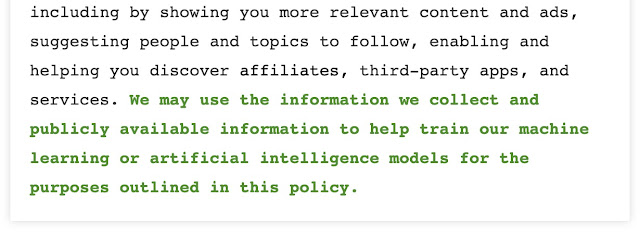
Today’s New York Times features an article that pulls back the curtain on how the AI handover is getting underway, how Google, Meta, X, et a...
-
 I was thinking the other day about the DNA of premium brands . One thing is certain -- it's a relative idea. For example, Hyatt is...
-
 I don't know who authored this quote, but I found it in this video of a presentation Yves Behar gave at TED about the need for design t...
-
 Today’s New York Times features an article that pulls back the curtain on how the AI handover is getting underway, how Google, Meta, X, et a...