The bubble project
I came across this piece on Rocketboom. The Bubble Project, the brainchild of former agency creative Ji Lee, gives people a voice to combat the one-sided corporate monologue. Nice initiative. And it seems be spreading around the world. Evidence of our pent up desire to be heard.

Creative destruction
I'm fascinated by the concept of creative destruction. It sometimes appears in articles debating the merits of corporate bailouts or the long-term silver lining found in a recession.
The premise behind creative destruction is that new and more innovative companies arise from the ashes of old and tired companies. From AOL, we get Google. From Radio Shack, we get Best Buy. From GM, we get Toyota. (And Toyota needs to be watching folks like Hyundai.) You get the idea.
How about the agency business? Where are the examples of creative destruction in the field of marketing communications? The models we might have pointed to several years ago -- media agencies, digital agencies -- haven't turned the industry on its head as we had expected.
What would be the hallmarks of an agency that feels fundamentally different and new? An agency that redefines the business? This is what I'm thinking about. Would love to hear suggestions.
The premise behind creative destruction is that new and more innovative companies arise from the ashes of old and tired companies. From AOL, we get Google. From Radio Shack, we get Best Buy. From GM, we get Toyota. (And Toyota needs to be watching folks like Hyundai.) You get the idea.
How about the agency business? Where are the examples of creative destruction in the field of marketing communications? The models we might have pointed to several years ago -- media agencies, digital agencies -- haven't turned the industry on its head as we had expected.
What would be the hallmarks of an agency that feels fundamentally different and new? An agency that redefines the business? This is what I'm thinking about. Would love to hear suggestions.
How to squander a big idea.
 I don't understand Tropicana's new packaging.
For years Tropicana was easily identified by its iconic symbol of a straw inserted into an orange. Nothing could say fresh orange juice faster or clearer. It's a unique and ownable mnemonic that nails the brand benefit.
 But Tropicana dumped this for, get this, a picture of a glass of juice. What could be more generic? Along with the new typography, the packaging exudes the feel of a store brand or a generic knock-off of a national brand. The existing packaging needed to be refreshed, but I think they went way too far by dropping the orange and straw.
This speaks to the fragility of great ideas. It takes years to build and own an iconic idea, but it takes only one bad decision to squander it.
Question for Microsoft
"Life without walls?" What walls?
One clear observation from CES is that the walls separating TV, phone and computer have come tumbling down. It strikes me that Microsoft may be answering a question few people are asking.

One clear observation from CES is that the walls separating TV, phone and computer have come tumbling down. It strikes me that Microsoft may be answering a question few people are asking.

Report from CES
Tech companies should be more familiar with the Prius Principle. Toyota's hybrid succeeded because it didn't ask us to change behavior. Instead it reshaped existing behavior. (Exactly why plug-in cars aren't widely embraced.)
This is the filter through which I viewed CES this week. Which technologies will succeed because they found a way to tap into our current behaviors?
That's why I'm doubtful about 3-D TV. Yes, I put on the glasses and, yes, I was amazed. But, no, I don't think I'll invite my friends over to watch the game and require them to sport Roy Orbison-esque glasses. (To be fair, there is buzz about the future potential of 3-D without the glasses. We'll see.)
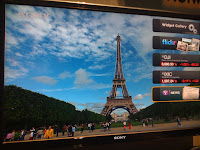
 Sony also has promising ways to bring more content and interactivity to our TVs. BD-Live and the PlayStation Store enable viewers to download new content to view on their TV, as well as to upload and share personal media with friends.
Samsung also demoed ways to seamless mesh our personal media and our TV sets. Their blu-ray player can stream content from NetFlix and Pandora. Their new sets also feature a USB drive (WiseLink Pro) that launches a menu to access photos, music and video stored on the jump drive. (Using jump drives passes the Prius test.)
Whereas Panasonic unveiled a 150" TV at last year's CES, this year thin is in. Sony has a Bravia that is only 9.9mm deep.
However, the technology that really impressed me is Sony's Flex OLED. Organic LED TVs are already hitting the market. They are brighter, use less power and are thinner than thin (3mm). Flex OLED, although still a concept, will bring about bendable screens. Imagine a laptop that opens to reveal full screen covering the entire area where the keyboard used to be. Or video screens bent around our wrist as jewelry (my idea, not Sony's...I'm keeping my day job).
 If you think screens are ubiquitous now, just wait til Flex OLED makes its debut. Ditto for the new vending machines that will be tested this summer at Simon Malls throughout the Southeast. They are basically touchscreen TVs that also dispense cold drinks. That too passes the Prius Principle. I like TV. I like Coke.

This is the filter through which I viewed CES this week. Which technologies will succeed because they found a way to tap into our current behaviors?
That's why I'm doubtful about 3-D TV. Yes, I put on the glasses and, yes, I was amazed. But, no, I don't think I'll invite my friends over to watch the game and require them to sport Roy Orbison-esque glasses. (To be fair, there is buzz about the future potential of 3-D without the glasses. We'll see.)
I'm also not sure about Polaroid's new digital camera that can also print out photos. Who wants to carry around a paper photo? Invoking the Prius Principle, this runs counter to how we currently share photos.

TV widgets seem to be the big idea this year. The Prius Principle bodes well for this new platform. After all, we like watching TV and we like MySpace. Why not do them at the same time? The underlying technology is backed largely by Yahoo and Intel and is going to be available on new sets offered by LG, Sony and Samsung.

 Sony also has promising ways to bring more content and interactivity to our TVs. BD-Live and the PlayStation Store enable viewers to download new content to view on their TV, as well as to upload and share personal media with friends.
Samsung also demoed ways to seamless mesh our personal media and our TV sets. Their blu-ray player can stream content from NetFlix and Pandora. Their new sets also feature a USB drive (WiseLink Pro) that launches a menu to access photos, music and video stored on the jump drive. (Using jump drives passes the Prius test.)
Whereas Panasonic unveiled a 150" TV at last year's CES, this year thin is in. Sony has a Bravia that is only 9.9mm deep.
However, the technology that really impressed me is Sony's Flex OLED. Organic LED TVs are already hitting the market. They are brighter, use less power and are thinner than thin (3mm). Flex OLED, although still a concept, will bring about bendable screens. Imagine a laptop that opens to reveal full screen covering the entire area where the keyboard used to be. Or video screens bent around our wrist as jewelry (my idea, not Sony's...I'm keeping my day job).
 If you think screens are ubiquitous now, just wait til Flex OLED makes its debut. Ditto for the new vending machines that will be tested this summer at Simon Malls throughout the Southeast. They are basically touchscreen TVs that also dispense cold drinks. That too passes the Prius Principle. I like TV. I like Coke.
What does IBM want us to do?
IBM is confusing me.
The company's recent "Stop Talking. Start Doing" campaign staked out an action-oriented positioning to appeal to business managers who've grown tired of new- age consultant blather and instead want to see real results.
Now IBM is running a new print campaign under the banner of "Think." Admittedly, the campaign has a different focus -- i.e., how to create a smarter planet by solving the climate, financial and energy issues that bedevil us. But wouldn't "stop talking / start doing" have applied to this as well? It seems to be what the world needs to do: act...now.
Which idea am I supposed to believe about the IBM brand? Is it the company we turn to for thought-provoking ideas or the company with the know-how to make innovation work?
The latter seems more in step with the times.
The company's recent "Stop Talking. Start Doing" campaign staked out an action-oriented positioning to appeal to business managers who've grown tired of new- age consultant blather and instead want to see real results.
Now IBM is running a new print campaign under the banner of "Think." Admittedly, the campaign has a different focus -- i.e., how to create a smarter planet by solving the climate, financial and energy issues that bedevil us. But wouldn't "stop talking / start doing" have applied to this as well? It seems to be what the world needs to do: act...now.
Which idea am I supposed to believe about the IBM brand? Is it the company we turn to for thought-provoking ideas or the company with the know-how to make innovation work?
The latter seems more in step with the times.
Time for the good stuff
I'm seeing more articles citing the increase in competitive advertising. The basic storyline goes something like this: the economy stinks, marketers need to be more effective, so they're dialing up more head-to-head competitive advertising.
One Interpublic executive was quoted in yesterday's WSJ saying, "Ads have to get competitive in bad times. It's a dog fight. It's about getting leaner and meaner."
Really? Was he knowingly serving up the ineffective stuff during the good times? I doubt it. When was the last time you heard a marketer or agency exec say, "Hey, let's hold that really effective idea until we need to sell something."
To be sure, competitive advertising has its role in the mix. It's a way to clearly convey a brand's advantages. It's particularly effective on-line and at point-of-sale. But if a brand adopts this as its sole message it runs the risk of becoming the grumpy McCain to the category leader's more inspiring Obama.
One Interpublic executive was quoted in yesterday's WSJ saying, "Ads have to get competitive in bad times. It's a dog fight. It's about getting leaner and meaner."
Really? Was he knowingly serving up the ineffective stuff during the good times? I doubt it. When was the last time you heard a marketer or agency exec say, "Hey, let's hold that really effective idea until we need to sell something."
To be sure, competitive advertising has its role in the mix. It's a way to clearly convey a brand's advantages. It's particularly effective on-line and at point-of-sale. But if a brand adopts this as its sole message it runs the risk of becoming the grumpy McCain to the category leader's more inspiring Obama.
Inspiration in seat 1B
I shared a flight yesterday with Alan Simon, the Chairman and CEO of Omaha Steaks. What an inspiring guy.
Omaha Steak is a nearly 180 year old family business. How many companies can claim that? Although Alan has since turned over day to day management to his 52 year old son, he still makes the commute from Orange County to Omaha twice a month because he loves the business so much. He finds the time to give back to the community by being on the boards of two universities. And he seems to know more about media technologies than most people half his age -- including me!
But the biggest delight was sensing I was meeting a man with the mischievous humor of a teenager.
It made having to fly on a Sunday afternoon worthwhile.
Omaha Steak is a nearly 180 year old family business. How many companies can claim that? Although Alan has since turned over day to day management to his 52 year old son, he still makes the commute from Orange County to Omaha twice a month because he loves the business so much. He finds the time to give back to the community by being on the boards of two universities. And he seems to know more about media technologies than most people half his age -- including me!
But the biggest delight was sensing I was meeting a man with the mischievous humor of a teenager.
It made having to fly on a Sunday afternoon worthwhile.
Marketing in a recession: Message from the front lines
A few weeks ago I conducted a marketing survey of senior executives across a range of businesses such as automotive, pharmaceuticals, toys, home remodeling, consumer electronics and retail.
I wanted to learn if there were common themes in the way a diverse group marketers was navigating the current recession (depression?).
Not surprisingly, all marketers are hurting and nearly every segment of their business is down. Lack of credit is affecting consumers and businesses alike. High priced premium segments, which seemed unaffected at first, have caved. Consumers are saving money by trading down to a lesser alternative or waiting for deep discounts on the products they desire. B2B purchases are drying up as companies cut CapEx budgets. There is a “slash and burn” mentality to marketing budgets.
But there are some bright spots as well.
Products and services that appeal to the consumer’s “cocooning” instinct – e.g., entertain at home, family games – are showing some resiliency.
Toys receiving heavy TV support seem to be holding up because parents may not want to scrimp on giving their kids what they want for Christmas.
Brands that feature a broad price range -- e..g, high/medium/low tiers, value bundles, etc. -- seem to be holding customers in the brand franchise.
Several executives reported that they are counting on their recent investments in new innovations to help weather the storm. “New” still attracts interest and curiosity.
However, if there is one single theme that is consistent across these marketers it is this: Get closer to your best customers.
Companies such as Allergan and Kohler, which sell through intermediaries, are investing in service and training to maintain loyalty among the people who recommend their products to end-users. For example, Allergan runs outreach programs designed to train physicians be better business people and run a more profitable medical practice.
Best Buy and Volvo are appealing to their best customers with more 1:1 marketing, private shopping events and loyalty incentives.
Land Rover and Sony are turning to smarter database marketing efforts.
Mattel is using street teams to put its electronic games into the hands of its priority customers.
Navistar is evaluating using more outbound telemarketing to better qualify and prioritize sales prospects.
I recently heard a quote that said, “never let a good crisis go to waste.” This captures the mood of theses marketers. The intensity of this recession is compelling many companies to reassess all aspects of their marketing plans.
Done right, many of the tactics they are using to survive today may continue to frame their strategies when the economy picks up again in the future. (And it will pick up again.)
Focus on your best customers. Do not take them for granted. Lavish them with appreciation and respect during the good times as well.
Focus your media spending. Digital media is the new branding medium, not just a tactical and transactional medium. Use a mobile call to action to transform all offline advertising into opt-in, interactive media.
Focus on the products in your portfolio that truly matter. Don’t get too broad and scattered. If a product isn’t delivering profitable growth, loyalty or a strategic halo for the brand, don’t waste precious resources even in good times.
I wanted to learn if there were common themes in the way a diverse group marketers was navigating the current recession (depression?).
Not surprisingly, all marketers are hurting and nearly every segment of their business is down. Lack of credit is affecting consumers and businesses alike. High priced premium segments, which seemed unaffected at first, have caved. Consumers are saving money by trading down to a lesser alternative or waiting for deep discounts on the products they desire. B2B purchases are drying up as companies cut CapEx budgets. There is a “slash and burn” mentality to marketing budgets.
But there are some bright spots as well.
Products and services that appeal to the consumer’s “cocooning” instinct – e.g., entertain at home, family games – are showing some resiliency.
Toys receiving heavy TV support seem to be holding up because parents may not want to scrimp on giving their kids what they want for Christmas.
Brands that feature a broad price range -- e..g, high/medium/low tiers, value bundles, etc. -- seem to be holding customers in the brand franchise.
Several executives reported that they are counting on their recent investments in new innovations to help weather the storm. “New” still attracts interest and curiosity.
However, if there is one single theme that is consistent across these marketers it is this: Get closer to your best customers.
Companies such as Allergan and Kohler, which sell through intermediaries, are investing in service and training to maintain loyalty among the people who recommend their products to end-users. For example, Allergan runs outreach programs designed to train physicians be better business people and run a more profitable medical practice.
Best Buy and Volvo are appealing to their best customers with more 1:1 marketing, private shopping events and loyalty incentives.
Land Rover and Sony are turning to smarter database marketing efforts.
Mattel is using street teams to put its electronic games into the hands of its priority customers.
Navistar is evaluating using more outbound telemarketing to better qualify and prioritize sales prospects.
I recently heard a quote that said, “never let a good crisis go to waste.” This captures the mood of theses marketers. The intensity of this recession is compelling many companies to reassess all aspects of their marketing plans.
Done right, many of the tactics they are using to survive today may continue to frame their strategies when the economy picks up again in the future. (And it will pick up again.)
Focus on your best customers. Do not take them for granted. Lavish them with appreciation and respect during the good times as well.
Focus your media spending. Digital media is the new branding medium, not just a tactical and transactional medium. Use a mobile call to action to transform all offline advertising into opt-in, interactive media.
Focus on the products in your portfolio that truly matter. Don’t get too broad and scattered. If a product isn’t delivering profitable growth, loyalty or a strategic halo for the brand, don’t waste precious resources even in good times.
Creating heroic brand narratives
I am intrigued by the art of storytelling in helping marketers create more meaningful and lasting brand identities.
Stories help us understand. They convey meaning. And in an increasingly overwhelming and fast-moving world, meaning trumps information.
If we step into the way-back machine and return to our English Lit classes, we might remember that stories are built on several essential elements, including archetypal characters, the hero's journey and resolution of conflict.
 Archetypes are the universal characters that form what Carl Jung called our collective unconscious. Over the millennia, we became hardwired to instantly recognize the meaning of archetypes like the outlaw, hero, ruler, jester, temptress, innocent and the everyman. Defining and expressing brands as archetypes may be more powerful than the traditional brand personality statement in creating a deep connection with consumers.

The "hero's journey" was first defined in Joseph Campbell's book on comparative mythology, "The Hero With A Thousand Faces." Campbell isolated the hero stories that recur in ancient fables, the Bible and Hollywood films. In short: a person ventures forth from the common world...confronts obstacles and adversaries...wins a decisive victory...and returns with the power to help their fellow man.
We see the Hero's Journey in Hollywood:
 An innocent young prince tries to run away from his troubles and instead discovers the redeeming power of friendship and truth.
 A farm boy leaves his family and unites with rebels and outlaws in an epic battle of good vs evil to save the world from the corrupt and villainous empire.
We see it in politics:
 A common man rises above racial barriers to inspire a nation to defy the divisiveness of red states and blue states and reclaim the promise of the United States.
We see it in brands :
:
 An advocate of women's self-esteem battling against the falsehood of media-defined beauty.
 An authority-defying rebel uniting a community in a crusade against fear.
Great brands tell great stories. The best among these find a way to be the hero in an ever-unfolding narrative. Like our favorite literary protagonists, heroic brands have a clear sense of true north that shapes their beliefs and behaviors.
True to Campbell's concept of the hero's journey, heroic brands make clear what it is they stand for by being equally clear about what they oppose. Classic brand positioning leads us to define what a brand stands for. The heroic brand model compels us to go further -- define the antagonist. After all, the most passionate causes tend to be in pursuit of both – a noble ideal that inspires us and a status quo that must be vanquished. It is the tension between these opposing forces that trumpets a call to arms.
The moral of this story? We need to stop thinking like advertisers and begin thinking like storytellers.
Stories help us understand. They convey meaning. And in an increasingly overwhelming and fast-moving world, meaning trumps information.
If we step into the way-back machine and return to our English Lit classes, we might remember that stories are built on several essential elements, including archetypal characters, the hero's journey and resolution of conflict.
 Archetypes are the universal characters that form what Carl Jung called our collective unconscious. Over the millennia, we became hardwired to instantly recognize the meaning of archetypes like the outlaw, hero, ruler, jester, temptress, innocent and the everyman. Defining and expressing brands as archetypes may be more powerful than the traditional brand personality statement in creating a deep connection with consumers.
The "hero's journey" was first defined in Joseph Campbell's book on comparative mythology, "The Hero With A Thousand Faces." Campbell isolated the hero stories that recur in ancient fables, the Bible and Hollywood films. In short: a person ventures forth from the common world...confronts obstacles and adversaries...wins a decisive victory...and returns with the power to help their fellow man.
We see the Hero's Journey in Hollywood:

 An innocent young prince tries to run away from his troubles and instead discovers the redeeming power of friendship and truth.
 A farm boy leaves his family and unites with rebels and outlaws in an epic battle of good vs evil to save the world from the corrupt and villainous empire.
We see it in politics:
 A common man rises above racial barriers to inspire a nation to defy the divisiveness of red states and blue states and reclaim the promise of the United States.
We see it in brands
 :
:
A free thinker liberating the world from beige conformity.
 An advocate of women's self-esteem battling against the falsehood of media-defined beauty.
 An authority-defying rebel uniting a community in a crusade against fear.
Great brands tell great stories. The best among these find a way to be the hero in an ever-unfolding narrative. Like our favorite literary protagonists, heroic brands have a clear sense of true north that shapes their beliefs and behaviors.
True to Campbell's concept of the hero's journey, heroic brands make clear what it is they stand for by being equally clear about what they oppose. Classic brand positioning leads us to define what a brand stands for. The heroic brand model compels us to go further -- define the antagonist. After all, the most passionate causes tend to be in pursuit of both – a noble ideal that inspires us and a status quo that must be vanquished. It is the tension between these opposing forces that trumpets a call to arms.
The moral of this story? We need to stop thinking like advertisers and begin thinking like storytellers.
Subscribe to:
Posts (Atom)
How the Handover Begins
Today’s New York Times features an article that pulls back the curtain on how the AI handover is getting underway, how Google, Meta, X, et a...
-
 I was thinking the other day about the DNA of premium brands . One thing is certain -- it's a relative idea. For example, Hyatt is...
 -
 I don't know who authored this quote, but I found it in this video of a presentation Yves Behar gave at TED about the need for design t...
 -
 Today’s New York Times features an article that pulls back the curtain on how the AI handover is getting underway, how Google, Meta, X, et a...