From today's article: "Social media is the new TV. In the era when television shaped mainstream consumer sentiment, companies enjoyed enormous power to alter their image through advertising. Then came the internet, which didn’t kill advertising, but did dilute its power. Brands now have little say over how their messages get chewed up through our social feeds. Yes, they can run ads on Facebook, Twitter, Snapchat and everyplace else. But social media elevates consumers over corporate marketing; suddenly what matters isn’t what an ad says about a company, but what your friends think about that company."
Wikibranding driving online brand activism.
Ten years ago I coined the term Wikibranding when it occurred to me that social media would cause brands to become increasingly crowd-defined. Ten years later, The NY Times has reached the same conclusion. :)

Ford vs Tesla.
Insightful assessment of Tesla vs Ford. From a financial standpoint, Ford has had five straight years of profits amounting to over $24 billion, while Tesla's losses total $2.2 billion over this same period.
From a product standpoint, Ford's Fusion Hybrid is now outselling the Prius. (Plus, Ford is investing $4.5B to create 13 electric vehicles over the next several years.)
Do I admire Tesla and Elon Musk? Absolutely. And I admire even more seeing a 114 year old company reinvent its future.
Here's the article.
Job vs a Profession.
 So happy today to be able to spend time with GTB's STRIVE team and talk with young professionals about ways to create a rewarding career in advertising. We discussed the difference between a job and a profession. When viewed as a profession, you commit to being in the business of building brands (not tactics); view your career as a journey of learning; know there is no substitute for hard work and preparation; and always have a POV. Above all, you dare to be wrong!
Facebook and Google want to be your TV network.
Facebook CEO Mark Zuckerberg has publicly outlined the company's ambitious Video First strategy, an effort likely to be as big as its previous push into mobile. At its core, the strategy is designed to make FB our first choice when we want to look at video.
The first steps are already in motion: Introduced a video-only tab; started promoting longer videos in the news feed; launched a video app for Samsung Smart TVs, Apple TV, Amazon Fire TV; and now will begin paying content creators for high quality, episodic content.
Not to be outdone, Google announced YouTube TV, a $35 monthly "skinny bundle" for cord-cutters, offering 40 channels and content from all four broadcast networks.
But the big news is the availability of live sports, one of the last viewing experiences that keeps many Americans, myself included, tethered by a cable wire. But YouTube TV will include some regional sports from ESPN.
It's important to monitor the success and growth of each. It's also important for marketers to think "video" and not "TV." They sound the same, but they are not.
Virtual Assistants a growing reality.
Alexa, mark my words, literally. Voice Assistants will set new expectations for how customers want to interact with brands, hardware, shopping sites and apps.
Then again, I saw this coming back in 2013 when I coined the expression #HandsFreeWeb in describing the future of web-enabled houses!
Now that Apple has announced HomePod, we will likely see an epic battle with Amazon Echo and Google Home for leadership in interactive voice.
Amazon Echo has become a surprise hit, putting Amazon well ahead of Google to lead the race toward applying natural human language to search and perform tasks. In a race to catch up, Google Home also uses AI to understand what users are saying and respond conversationally.
Going forward, I can see a day when typing into a keyboard, whether a phone, tablet or PC, will be viewed as time consuming and old fashioned.
Want to work in Marcom? Learn to write!
This was drilled into me when I started my career at Ogilvy. I am a better business leader as a result. This is a must read...and do.


Your brand's multicultural strategy is also its growth strategy.
 New census data shows that minorities are now the majority in 12% of counties across the U.S. In 370 counties across 36 states, non-Hispanic whites accounted for less than half the population as of July 2015.
And this trend will accelerate. Three quarters of Americans age 55+ are white. Whereas among those aged 18-34, that figure drops to only 56%, and even lower among minors.
In explaining his greatness, Wayne Gretzky credited his father's advice to skate to where the puck is going, not where it is.
For marketers, that mean skating to an increasingly multicultural customer base.
Why I love working in advertising.
I love working in advertising.
We help companies care about their customers' hopes and dreams. We help companies grow. We get to collaborate with smart, funny, talented people with diverse backgrounds and interests.
Several times a year I serve as a guest lecturer at University of California, Irvine and Chapman University. I enjoy mentoring the next generation of advertising professionals. They remind me how lucky I am. When I look out across the classroom, I see in their eyes that they would walk across hot coals to be doing what I do.
I always begin my talks with my profession of love and appreciation for my career in advertising, for being able to spend my days at the intersection of business and everything imaginable. A day in advertising is a day spent absorbing market dynamics; social trends; new technologies; design; emerging media platforms; pop culture influences. It's a business of ideas – ideas born of hard work, knowledge and serendipity.
True, it can be a day and night job. And it can be emotionally draining and stressful. But, again, we get to work in a business of ideas. That doesn't suck.
I recently spoke to a group of University of Michigan students who asked me to share my advice as they embark on their careers. Here's what I told them:
- Pursue a profession, not a job. Whatever you decide to do, be the consummate professional. Accumulate skills and knowledge. Be great at a few things and not simply average at many things.
- Be curious. Embrace your career as a journey of learning. You need not know everything. But you need to ask more interesting questions of those who do know. Questions provoke ideas and progress.
- Fail. Learn. Repeat. (Need I say more?)
- Be accountable. Blaming others is not only is a waste of time, it's a wasted opportunity to learn and grow. Victimhood serves no purpose.
- Be dependable. We value people who do what they say they're going to do. (True in life, true in business.) Demonstrate early on in your career your ability to get things done.
- Solve problems. Don't whine about problems. It's what we're paid to do. The sales graph pointing downwards is a problem. Unhappy franchisees is a problem. High bounce rates on a website is a problem. Negative brand perceptions are a problem. We fix problems.
- Have a voice. Meetings aren't a spectator sport. Have the courage to show you are a thinking individual. Always have a point of view. Don't worry about whether your perspective is right or wrong. Expressing your idea will be a catalyst for others to challenge or build upon it. And this is how ideas are born, from the collision of diverse perspectives.
- Reimagine yourself, often. Don't allow yourself to grow stale. Enroll in the training your company offers. Accept opportunities that force you to learn. Creative people must continually evolve. Years ago I had the good fortune to attend a talk given by George Martin, the legendary producer of the Beatles. This was his lasting lesson from the Beatles – they experimented and took risks and, by doing so, avoided a repetitious formula.
- Always ask "why" and "why not." These two seemingly simple questions pack tremendous power. Why challenges the status quo while also signaling curiosity. Why not is the eternal anthem of optimists. It's hard to go wrong navigating by these two questions.
- Learn to be a commercial anthropologist. I believe this is central to succeeding in advertising. Your anthropologist side requires a fascination with people and the strength to observe without judgement. The commercial side is a constant reminder that advertising exists to help companies sell. Keep both sides in equal balance. Too much human observation without bottom line impact isn't good. Too much selling devoid of human insights creates a commodity business.
My parting advice to these students is always the same: I don't care what you end up doing. But thirty years from now, make sure you can stand up and say "I love what I do for a living."
Hard work and luck.
Companies can be customers. Or clients. Or even partners. But to me they have been teachers. I feel very fortunate to have had the opportunity to work with 17 companies listed in Fortune Magazine's 2016 compilation of the world's most admired companies.
P&G – Coca-Cola Company – Unilever – UnitedHealth Group – Aetna – American Express – JP Morgan Chase – Hilton – Sony – Medtronic – Applied Materials – Pulte Homes – Best Buy – United – Ryder Systems – Toyota – Ford.
I continue to learn from all my clients.
P&G – Coca-Cola Company – Unilever – UnitedHealth Group – Aetna – American Express – JP Morgan Chase – Hilton – Sony – Medtronic – Applied Materials – Pulte Homes – Best Buy – United – Ryder Systems – Toyota – Ford.
I continue to learn from all my clients.
How social media is changing new product reveals.
 This New York Times article offers a fascinating perspective on how social media is changing product reveals.
This is now the case in fashion. I wonder if this dynamic is also in play in automotive and consumer electronics – two industries that also reveal products well in advance of the on-sale date.
Interestingly, the music industry is embracing a different reveal strategy – artists now "drop" a new release with no advance notice. In doing so they own the social news cycle, burning hot and bright at the very moment when the "product" is on sale.
Something for marketers to consider.
Subscribe to:
Posts (Atom)
How the Handover Begins
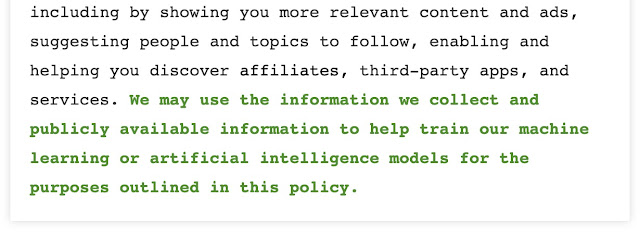
Today’s New York Times features an article that pulls back the curtain on how the AI handover is getting underway, how Google, Meta, X, et a...
-
 I was thinking the other day about the DNA of premium brands . One thing is certain -- it's a relative idea. For example, Hyatt is...
-
 I don't know who authored this quote, but I found it in this video of a presentation Yves Behar gave at TED about the need for design t...
-
 Today’s New York Times features an article that pulls back the curtain on how the AI handover is getting underway, how Google, Meta, X, et a...