Love this video..."Leadership lessons from dancing guy." So true, it's not about the leader, it's about the risk taken by the early followers. That's how movements happen.
Handbook for left brainers.
I was invited this week to speak to a group of marketing executives at Kimpton Hotels about how to become a more creative thinker.
If you're familiar with Kimpton, then you know the company is creative to its core. Michael Depatie, Kimpton's CEO, exhorts employees to "celebrate the tries, even if they don't work." Niki Leondakis, Kimpton's President, supports a culture of creativity by saying "if you're not willing to laugh at yourself and be silly, then we're probably not the company for you."
Clearly I was not there to inspire Kimpton to be creative, but rather to provide a framework and useful tools to help teams create bigger ideas more frequently.
To me, creativity is not a fluffy art, it is counter-intuitive problem solving. The first step is to recognize and avoid the top three creativity killers: (1) We accept assumptions and solve the wrong problem; (2) We know what we know and narrow the scope of our thinking to ideas that are familiar (perceptual narrowing); (3) We lock down too soon and don't pursue multiple solutions (divergent thinking).
My framework for creative problem-solving follows four steps:
If you're familiar with Kimpton, then you know the company is creative to its core. Michael Depatie, Kimpton's CEO, exhorts employees to "celebrate the tries, even if they don't work." Niki Leondakis, Kimpton's President, supports a culture of creativity by saying "if you're not willing to laugh at yourself and be silly, then we're probably not the company for you."
Clearly I was not there to inspire Kimpton to be creative, but rather to provide a framework and useful tools to help teams create bigger ideas more frequently.
To me, creativity is not a fluffy art, it is counter-intuitive problem solving. The first step is to recognize and avoid the top three creativity killers: (1) We accept assumptions and solve the wrong problem; (2) We know what we know and narrow the scope of our thinking to ideas that are familiar (perceptual narrowing); (3) We lock down too soon and don't pursue multiple solutions (divergent thinking).
My framework for creative problem-solving follows four steps:
- Define: Create a ruthlessly well-honed statement of the problem – challenge assumptions; be specific about what you want to achieve.
- Know: Gather new and relevant information to disrupt preconceptions.
- Collaborate: Remember that ideas get bigger when they result from the collision of disparate perspectives, experiences and people.
- Invert: Consider the problem from a radically different perspective to disrupt familiar mental routines and get to new and innovative solutions.

Re-imagine your website as a branded newsroom.
Ian Schafer's article prompts an interesting idea.
Normally we design websites to get people to visit the brand. What if we changed the goal and instead designed a website programmed around socially shareable content?
By "programming" Mr. Shaffer is suggesting that we keep the content fresh and interesting on a daily basis, similar to the continuous editorial decisions made at an entertainment news website or TV network.
This would require that the website be led by an editor-in-chief charged with making daily content decisions about news/videos/tips that will increase the brand's chances of being shared within social networks. Like the article suggests, the website would be run like a newsroom.
Love ideas such as this that totally reframe a problem.
The importance of brand empathy.
This piece from HBR corroborates they key themes I've advocated in my 4Es branding model.
HBR calls into question the commonly accepted belief that customers want relationships with brands. They don't. It goes on to point out that what customers seek is a sense of shared values.
That's why I've embraced a brand planning model based on the power of empathy.
As I've written previously, I believe that the way in which we form brand relationships mirrors how we form personal relationships. Forces such as empathy, experiences, energy and endorsement help form our real life relationships.
Empathy tends to be the basis of our strongest and lasting personal relationships. We connect with people who share our values, sense of style, even our sense of humor. This holds true with brands. Brand empathy occurs when customers project onto your brand their own attitudes and values.
Like people, brands are judged by what they do, not just by what they say. We tend to believe something after we've experienced it first hand. In marketing, well orchestrated brand experiences help turn perceptions into beliefs when customers sense a brands words and actions are in sync.
HBR calls into question the commonly accepted belief that customers want relationships with brands. They don't. It goes on to point out that what customers seek is a sense of shared values.
That's why I've embraced a brand planning model based on the power of empathy.
As I've written previously, I believe that the way in which we form brand relationships mirrors how we form personal relationships. Forces such as empathy, experiences, energy and endorsement help form our real life relationships.
Empathy tends to be the basis of our strongest and lasting personal relationships. We connect with people who share our values, sense of style, even our sense of humor. This holds true with brands. Brand empathy occurs when customers project onto your brand their own attitudes and values.
Like people, brands are judged by what they do, not just by what they say. We tend to believe something after we've experienced it first hand. In marketing, well orchestrated brand experiences help turn perceptions into beliefs when customers sense a brands words and actions are in sync.
Nostradamus and social media

This may or not be true. I don't know. I'm not sure even the great 16th Century seer could give us guidance.
However, I do believe that the way in which we'll use this medium in the future will be very different than how we're using it today. It will evolve in ways we cannot yet see, and in doing so will become more useful for marketers.
Why do I believe this? Sometimes the past can give us a clue to the future.
Back in the late '90s, and even in the early 2000s, the way in which agencies and marketers used the web bears no resemblance to the way in which we're using it today. First of all, dial-up was the dominant access method, so it was unrealistic to use rich images and long-form video (the dominant form of interactive marketing today). Second, we were very inexperienced in this new medium, so we treated the web as a one-way, broadcast version of a brochure.
Back in the 2000s, there were breathless predictions about the advent of interactive television. The battle for control over this new form of marketing was being defined by the set-top box – the source of viewer interaction. Or so we thought, until recently when we began witnessing the emergence of "second-screen" viewing, in which viewers interact with broadcast content through a smartphone, tablet or laptop.
In the case of the web, we couldn't see a near future in which broadband would change the online experience, and how the web would evolve from a broadcast medium into a service channel. And as for interactive television, we didn't see the iPhone coming.
The moral of the story is that we should not define a medium's future potential based on our current practices and the current state of its technology.
So will social media evolve into a powerful marketing platform? Probably. But not in the form in which it exists today. Savvy agencies and marketers will test, learn and be ready for what comes next.
Oh, in case you're wondering, @Nostradamus has 1,449 followers.
Homeward. Onward.
"Man cannot discover new oceans unless he has the courage to lose sight of the shore." ~ Andre Gide
This is one of life's bittersweet moments. I'm choosing to lose sight of the shore in order to get back to the ocean I love. After five amazing years, I have decided to leave Barrie D'Rozario Murphy and return home to Southern California.
"Twenty years from now you will be more disappointed by the things you didn't do than by the ones you did do. So throw off the bowlines. Catch the trade winds in your sails. Explore. Dream. Discover." ~ Mark Twain
Here's to knowing when it's time to set sail for new lands, and to knowing when it's time to point the compass back towards home.
Homeward. Onward.
This is one of life's bittersweet moments. I'm choosing to lose sight of the shore in order to get back to the ocean I love. After five amazing years, I have decided to leave Barrie D'Rozario Murphy and return home to Southern California.
Partnering with Bob Barrie and Stuart D'Rozario and everyone at BD'M has been one of the most rewarding experiences of my career. Bob, Stuart and I always joked that in 2007 we ran off together to join the circus – an experience I will always cherish and would never trade. We had fun. We did well. Together, we built an award-winning agency that earned the confidence of clients such as Dell, Lands End, Del Webb, Wagner, Medtronic, Applied Materials, Best Buy and United Airlines. Along the way we were named "Best Small Agency in the U.S." by the 4As. We won some EFFIES and a Gold Lion in Film at Cannes. Not to shabby for our "grown up start up."
While I'm sad to leave the many friends I have in Minneapolis, my decision to return home is a happy one because it will allow me to spend more time with my daughters, plant roots and have just one place that I call home. Also, those who know me well know that I'm a sea critter – I am happiest by ocean. And as luck would have it, Lambesis overlooks the beach. (Several of my friends told me they knew something was up when I posted recently on Facebook that I was no longer selling my boat. I have clever friends.)
"Twenty years from now you will be more disappointed by the things you didn't do than by the ones you did do. So throw off the bowlines. Catch the trade winds in your sails. Explore. Dream. Discover." ~ Mark Twain
Here's to knowing when it's time to set sail for new lands, and to knowing when it's time to point the compass back towards home.
Homeward. Onward.
Celebrating creative brilliance in Cannes
I tip my hat to my peers whose work has been justly celebrated in Cannes. This is the level of creative innovation that keeps me excited and passionate about my profession. To echo the great Adidas mantra – impossible is nothing.
Here's some of the work that not only inspires me, but clearly inspired the judges in Cannes:
Solar Powered Annual Report:
Austria Solar and its design firm, Serviceplan Munich, produced this Annual Report that featured nothing on its pages until you exposed it to sunlight – a brilliant way to reinforce the company's mission. (Watch this video to see it in action.)
 Nike Fuelband:
Nike's new Fuelband is a sleek wristband that allows you to track daily calorie burn throughout the day. It's brilliance is not just its design or function but its ability to seamlessly integrate the Nike brand into your entire day, beyond the gym. Kudos to Nike and R/GA. (See the commercial.)
 Mercedes Invisible Drive
How do you promote a zero-emission vehicle? Make it invisible. And that's what Mercedes and its agency, Jung Von Matt, did by covering the car with LED lights that displayed images from cameras mounted on the side of the car, creating the illusion that the car was "invisible." (Watch the video.)

Here's some of the work that not only inspires me, but clearly inspired the judges in Cannes:
Solar Powered Annual Report:
Austria Solar and its design firm, Serviceplan Munich, produced this Annual Report that featured nothing on its pages until you exposed it to sunlight – a brilliant way to reinforce the company's mission. (Watch this video to see it in action.)

Nike's new Fuelband is a sleek wristband that allows you to track daily calorie burn throughout the day. It's brilliance is not just its design or function but its ability to seamlessly integrate the Nike brand into your entire day, beyond the gym. Kudos to Nike and R/GA. (See the commercial.)

How do you promote a zero-emission vehicle? Make it invisible. And that's what Mercedes and its agency, Jung Von Matt, did by covering the car with LED lights that displayed images from cameras mounted on the side of the car, creating the illusion that the car was "invisible." (Watch the video.)

A jargon-free approach to brand planning.
Today I had the opportunity to be the guest speaker at Chapman University's Internet Communications class. Cory O'Connor, the Assistant Professor who extended the invitation, knows a thing or two about shaping strong brands, having been Sr. VP for the Disney Channel, so I was honored to get the call.
My goal was to outline a few themes that have bounced around this blog, particularly that marketing communications professionals should embrace marketing's new normal by eschewing tired distinctions between "online" and "offline", "traditional" vs "nontraditional", as well as my favorite old school term – "new media." Further to my crusade to simplify planning by stamping out jargon, brand pyramids and Venn Diagrams, I also outlined my simple belief that what is true in life is true in marketing – i.e., they way in which we form personal relationships mirror how we form brand relationships.
As always happens when I speak to students, I think I'm the one who comes away more inspired about my profession when I see the passion they have to enter it.
My goal was to outline a few themes that have bounced around this blog, particularly that marketing communications professionals should embrace marketing's new normal by eschewing tired distinctions between "online" and "offline", "traditional" vs "nontraditional", as well as my favorite old school term – "new media." Further to my crusade to simplify planning by stamping out jargon, brand pyramids and Venn Diagrams, I also outlined my simple belief that what is true in life is true in marketing – i.e., they way in which we form personal relationships mirror how we form brand relationships.
As always happens when I speak to students, I think I'm the one who comes away more inspired about my profession when I see the passion they have to enter it.
Why diversity matters in advertising.
The imperative to create a more diverse agency culture is not something we should do because it is politically correct. It's something we must do to ensure the long-term success of our industry.
We are in the business of helping clients build their business through our unique ability to understand and connect with main street America. We did this well over the years largely because we tended to mirror the face of America. As the American landscape continues to become more diverse, so must agencies, or we risk falling out of touch with consumers and becoming less capable of providing clients with fresh, relevant ideas.
In many states across the U.S., multicultural markets are increasingly mainstream – not just in California and New York, but also in states like Delaware, Maryland, Louisiana and Nevada. In each of these states the white population accounts for about two-thirds or less of the total (2010 US Census).
If you want a glimpse of the future, look no further than the ethnicity of the youth market: among people under 18 years old, whites make up only 57% of this cohort. Millennials have grown up during a time marked by dramatic growth in immigration and racial integration. Multiculturalism is simply a fact of life for this group, reinforced early on by Sesame Street, and later in the classroom, as well as in film and music.
This film, The Pursuit of Passion: Diversity in Advertising, makes the case in an inspiring way.
We are in the business of helping clients build their business through our unique ability to understand and connect with main street America. We did this well over the years largely because we tended to mirror the face of America. As the American landscape continues to become more diverse, so must agencies, or we risk falling out of touch with consumers and becoming less capable of providing clients with fresh, relevant ideas.
In many states across the U.S., multicultural markets are increasingly mainstream – not just in California and New York, but also in states like Delaware, Maryland, Louisiana and Nevada. In each of these states the white population accounts for about two-thirds or less of the total (2010 US Census).
If you want a glimpse of the future, look no further than the ethnicity of the youth market: among people under 18 years old, whites make up only 57% of this cohort. Millennials have grown up during a time marked by dramatic growth in immigration and racial integration. Multiculturalism is simply a fact of life for this group, reinforced early on by Sesame Street, and later in the classroom, as well as in film and music.
This film, The Pursuit of Passion: Diversity in Advertising, makes the case in an inspiring way.
Tips on starting a successful agency career.
I was invited last night to speak to the Chapman University Ad Club and offer career advice to these aspiring advertising agency professionals.
This is a switched-on group, many of whom are preparing to compete in the Ad Fed National Student Advertising Competition. Having just judged the District 10 regionals in Shreveport, I know how long and hard they've been working on their presentation.
As I told the group last night, this summer will mark my 30th year in advertising, I still love what I love what I do for a living, mainly because advertising sits at the intersection of everything – business, art, pop culture, technology, societal trends, the media revolution.
I thought I'd share an abbreviated copy of my slides in the hope that it will provide some inspiration and guidance to those who want to be equally passionate about their career in 2042.
This is a switched-on group, many of whom are preparing to compete in the Ad Fed National Student Advertising Competition. Having just judged the District 10 regionals in Shreveport, I know how long and hard they've been working on their presentation.
As I told the group last night, this summer will mark my 30th year in advertising, I still love what I love what I do for a living, mainly because advertising sits at the intersection of everything – business, art, pop culture, technology, societal trends, the media revolution.
I thought I'd share an abbreviated copy of my slides in the hope that it will provide some inspiration and guidance to those who want to be equally passionate about their career in 2042.
Subscribe to:
Posts (Atom)
How the Handover Begins
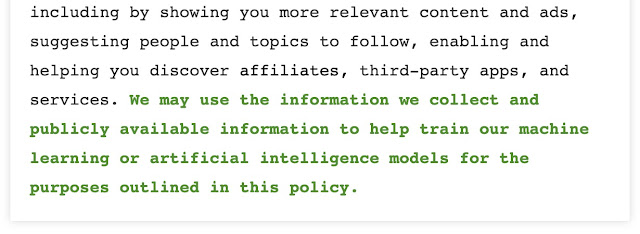
Today’s New York Times features an article that pulls back the curtain on how the AI handover is getting underway, how Google, Meta, X, et a...
-
 I was thinking the other day about the DNA of premium brands . One thing is certain -- it's a relative idea. For example, Hyatt is...
 -
 I don't know who authored this quote, but I found it in this video of a presentation Yves Behar gave at TED about the need for design t...
 -
 Today’s New York Times features an article that pulls back the curtain on how the AI handover is getting underway, how Google, Meta, X, et a...