Rehumanizing Artificial Intelligence


The news media has been abuzz with hand-wringing reports about how ChatGPT will undermine academic integrity. 

However, the Artificial Intelligence genie is out of the bottle. AI is happening. It will scale. Its applications will extend to many aspects of daily life, including education. (Microsoft is banking on this, having just invested $10B in OpenAI, the red-hot AI lab behind ChatGPT.) 

Every minute we spend romanticizing how things used to be is time we’re not designing ways to harness change. 

We heard similar laments years ago when students started using Google Search instead of the encyclopedia; when parents began tethering their kids with mobile phones; when social media became an addictive currency. Over time, we learned to harness something positive from each – access to knowledge; safety; a generation of creators – while remaining vigilant about their dark sides. 

Even before ChatGPT, the quality of writing seems to have been deteriorating for decades, at least within the context of the workplace. Many recent graduates struggle writing a succinct, well-punctuated email let alone a compelling presentation. 

ChatGPT is not a threat to the quality of writing; what’s at stake is the quality of thinking. 

The central question isn’t how to stop students from using ChatGPT – rather, how might educators use AI to teach valuable skills? 

For example, what if an educator designed an assignment to demonstrate the most important aspect of ChatGPT – i.e., the role of the questions posed by humans:
  • Ask students to choose a subject and prompt to get an AI-written essay; 
  • Then have students slightly modify the prompt and get a second output;
  • Most importantly, have students write an argument comparing the two AI-scribed essays and how the different prompts altered the outcomes. 
Now we’re using AI to teach critical thinking; the relationship between inputs and outputs; forming better questions. 

What if an educator used ChatGPT to teach better writing skills by demonstrating the value of proper editing? 
  • Require students to use ChatGPT to get their first draft.
  • Then ask students to edit by half, requiring them to prioritize information; identify unnecessary words; learn that less is more. 
These are two small examples. Professional educators will think of better ones. 

By the way, I asked ChatGPT how an educator might use it as a teaching tool. Here is its response: 


Let’s fast-froward to ideas that harness AI to help sharpen the uniquely human skills that students, and all of us, need to succeed in life.

PS: I created the illustration for this article using DALL-E – ChatGPT’s AI graphics sibling – by inputting this prompt: "Painting of a university professor arguing with a student in the style of Johannes Vermeer."

Let's rehumanize marketing!


Every new marketing model seems to move farther from a fundamental truth – there’s a human on the other side of the screen.

We can sense this growing chasm in marketing's increasingly de-humanized vocabulary – addressable markets, cohorts, targets, segments; we can sense it in blunt, one-size-fits-all multicultural definitions and generational tags.

Despite being awash in data and analytics that tell us what customers did, most companies don’t fully understand why their customers behave the way they do.   


A Harvard Business Review Analytical Services study found that just 23% of executives believe their organization understands their customers’ motivations. (Even if this has doubled since 2019 that's still not great.)

Customer Experience, or CX, comes closest to embracing a human-centered truth. Yet here we are in 2023 and CX remains siloed in many organizations. 

Being human-centered is not about going analog. Far from it! Data and marketing technologies have given us superpowers in our ability to be more relevant and personalized.


This is about shifting our mindset – making empathy a core skill; designing more human-centered ways to organize teams; truly understanding what it means to have a relationship with a customer.

Being Human: 101

In my recent university lectures, I speak to students about human behavior and the power of empathy. With a clear nod to Abraham Maslow, here’s how I summarize for them our basic human motivations:

We create relationships as a way to help satisfy these needs, and the strongest begin are sustained through empathy – the ability to see through the eyes of another, without judgement. Empathy helps form meaningful relationships because it builds trust.

If this is true in life, why isn’t this consistently true in marketing?

Prioritizing the “R” in CRM

Several years ago I realized the mistake I had long been making.

While giving a presentation I noticed I was repeating the word relationship on slide after power-pointy slide, e.g., customer relationship, brand relationship, CRM. I hadn't yet invested time to unpack this simple word to understand the dynamics of real relationships.

That “ah-ha moment” helped crystalize a simple truth: what’s true in life should be true in marketing – how we form personal relationships should guide how we form customer relationships.

And that truth ultimately inspired Rehumanize, a marketing consultancy that helps organizations and people grow by harnessing the power of empathy and human relationships.


Rehumanize organizes goals, metrics, and teams around the four dynamics of human relationships – empathy, experiences, endorsement, and energy – aka, "The 4Es."


Connecting the Dots

Rehumanize's 4E Loyalty Model represents System Thinking – i.e., a way to make sense of complexity by viewing a problem in terms of wholes and relationships rather than its parts. In this case, the "whole" is the dynamics of human relationships.

This is what differentiates the 4E model from CX and CRM. Unlike those strategies, 4E integrates the contributions of other disciplines such as media communications, social media, event marketing, influencer strategies, product development, etc.

4E connects the dots across the enterprise – the benefit of systems thinking – to create a human-centered model to organize and analyze data, plan and prioritize strategies, and foster collaboration across teams.

Designing a human-centered organization sounds daunting, yet the necessary data, resources and skills likely already exist in your company but are disconnected from each other.

The 4E Loyalty Model is underpinned by the metrics we use every day, but live in different organizational silos, scattered across disparate reports, discussed in separate meetings.


When seen through the 4Es, these metrics realign to paint a clear picture of the opportunities, progress, and work to be done.


Teams in Marketing, Behavioral Analytics, UX/CX, Customer Care, Product and Corporate Comms all contribute. 4E creates a common vocabulary, shared planning model, and aligned KPIs.


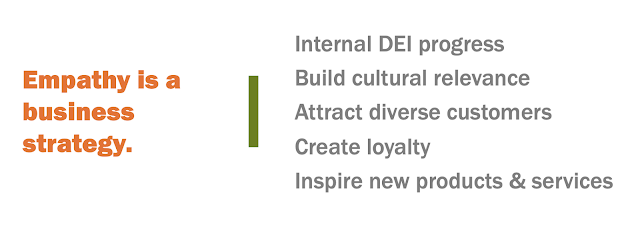
Empathy is a business strategy

Empathy may sound soft, but 4E is a measurable, outcome-oriented system that align goals, analytics and action.

Empathy helps accelerate progress on DEI initiatives; it can build authentic cultural relevance and growth among diverse customers; it can strengthen the effectiveness of a company’s CRM investments; it helps inspire new product development.

Spiderman and Maya Angelou agree.

While it’s true that Big Data and Martech have given us marketing superpowers, it’s also true that “with great power comes great responsibility” (as Uncle Ben advised Peter Parker, aka Spiderman).

Our responsibility is to use human insights, data and technology to better serve customers – to help organizations and people grow by harnessing the power of empathy and human relationships.

Marketing leaders have always had to hold in their mind two seemingly contradictory ideas: Marketing is about customer empathy; marketing is about profitable growth.

Each statement is true. Each is less effective without the other.


And here, I step aside and let Maya Angelou summarize my 29 paragraphs in 22 words.


Will this be your first recession rodeo?

In a previous article I referenced Mark Twain’s quote, “history doesn’t repeat itself, but it often rhymes.”  If true, then this is a poem about marketing in a recession by reflecting on lessons which I will attempt to freshen...Ok, no more poetry.


I recently revisited the WikiBranding articles I wrote during the 2008-2009 meltdown that spotlighted best practices from a range of marketers.  It struck me that those of us who guided businesses through The Great Recession can share lessons we learned with managers for whom this downturn might be their first.  (Bob Barrie, Stuart D’Rozario and I had just co-founded BD’M; learning how to navigate the recession was not a choice!) 


Who decides if we’re in a recession? 


Spoiler alert:  the consumer decides.


News stories about the economy lead us believe we’re in a recession – the “R-word” is having its moment.  


Economists might say otherwise, based on their often used definition of a recession, i.e., two consecutive quarters of falling GDP.  Other economists take a more holistic view to define a recession, e.g., labor market, consumer and business spending, industrial production, and income. 


Taking that wider view, payrolls increased in June, as did hourly wages, both growing faster than expected, as well as consumer spending.  


All good, right?  Hardly.


These broader data points miss a deeper point.  Consumer spending accounts for 70% of GDP, therefore when consumers feel we’re in a recession, their behaviors follow suit.


And that seems to be what’s happening.  


New polls show 58% of Americans believe the country is in a recession, up from 48% in May.  Unsurprisingly, consumer confidence has declined for three consecutive months.  And all this is happening in an environment where inflation is at a 40 year high and the average 401k is taking a beating.  It’s easy to understand why consumers feel anxious.


Lessons from the Great Recession


It’s worth taking stock of the present day and see how the forces that caused the Great Recession differ from what we are currently experiencing.


The 2008 recession was caused in large part by greed.  Lenders knowingly dealt toxic subprime mortgages and consumers gorged on easy credit to borrow and buy more than they should.  Financial regulators were asleep at the wheel, or worse yet, complicit.  (I’m dusting off “The Big Short,” Michael Lewis’ epic recount of that economic wildfire.)


This slowdown is different; it was caused largely by the pandemic.  In 2020 companies worldwide shut down, reduced output, and laid off workers.  Fast forward to 2022 and we see how this crippled the global supply chain which cannot keep pace with the post-pandemic spike in demand (i.e, “pleasure revenge”), leading to inflationary prices.  


So here are some lessons from the Great Recession that today’s marketing leaders may want to consider. 


Fear was the enemy:  


In 2008, in an environment of layoffs and home foreclosures, the vast majority of consumers were not at risk of losing their income or home, yet began cutting back on spending because they were uncertain about the future.  Back then, most automotive marketers defined affordability as the problem and set out to solve that through cut rate financing and lease rates.  


Hyundai did something different.  The company correctly diagnosed fear as the problem to be solved – the consumer’s uncertainty about might happen – and launched its successful Assurance program, allowing consumers to return their new car within a year if they lost their job. 


Discounting didn’t differentiate:  


Marketers in many categories attacked the affordability problem through unsustainable price cuts that eroded long-term pricing power.  Circuit City filed for bankruptcy, proving discounting alone was a race to the bottom.


Best Buy, a client of BD'M that was facing the risk of becoming Amazon’s showroom, took action on two fronts by matching online pricing while also adding unique value (and customer reassurance) through its in-store Blue Shirts and in-home Geek Squad.  Both actions helped Best Buy beat online retailers by offering something they could not – service and support.  


Customers have long memories:  


Many B2B companies slashed support budgets – e.g., downsized sales force, training, and customer service – as a way to cut costs, leaving their customers to dangle in the economic wind.  


Other companies found unique ways to get closer to their customers.  American Express launched Small Business Saturdays to support main street merchants hammered by the downturn.  Ford Dealers still recall how Ford Motor Credit was their lifeline during the Great Recession, extending much-needed lines of credit.  Allergan ran outreach programs to train physicians to run a more profitable medical practice.


Don’t let a good crisis go to waste:  


If necessity is the mother of invention, then a recession is the father of cool objectivity.  A recession creates a rare opportunity to reevaluate strategies that worked in good times; a time to think how you might refocus and reprioritize your product portfolio, marketing and media mix for the road ahead.


BD'M worked with United Airlines to develop Travel Options – an a la carte pricing program that enable flyers to design and pay for the experiences they valued – a merchandising strategy United still uses today.


Don’t put innovation on pause:  


Customer, marketplace and competitive dynamics move too fast to make standing still anything less than a corporate death-wish.  Even in a recession, consumers have needs that remain unmet by the competition.  


Remember, Apple waved its magic wand and lifted our spirts (and opened our wallets) during the Great Recession with must-have iPhones and MacBooks.


We are the supply chain problem.


We can’t go a day without hearing, or sharing our own story, about a seemingly simple purchase that is taking eons to arrive, an impatience that has heightened in a next-day culture.

In casual conversations we hear people cite the cause as having something to do with lazy workers, politicians, Russia’s aggression in Ukraine, or myriad other heard-then-repeated explanations.

Turns out, we are the problem: Our business models, our disconnected systems, our labor practices, our personal shopping choices. We are the forces straining the system.

That’s why this WSJ video is so fascinating. It starts with the sobering truth, that global demand is greater than what supply chains can handle. From there it unpacks the thorny thicket of disconnected problems raging through the system – i.e., through factories, ocean shipping, ports, trucking, and distribution centers – all made worse by rapid changes in DTC business models and the resulting shift in consumer shopping behavior.

And, spoiler alert, this story might not have a happy ending. Our supply chains may be forever strained without a massive rethink of how we solve – and connect– the problems.

For those of us who don't have time to binge a 54 minute video, here are some key highlights:

Supply Chains scaled down when Covid hit (e.g., capacity, inventories, labor, etc), expecting that global consumer demand would contract.  It didn’t. 

Shipping ports are a fragile point of failure.  Our ports, most notably the Port of Long Beach here in the US), represent a singular intersection of the problems spanning ocean shipping, trucking, labor and consumer demand. 

We don’t have enough truckers in the US.  Nearly 10M people have a CDL license yet only 3.5M are driving. Why? They are poorly paid (new drivers barely earn minimum wage), are seldom home, and work 14+ hour days. 

Seismic changes in consumer behavior, acclerated by eCommerce and DTC models, are further straining supply chains, which must now deliver more products to specific addresses instead of mass deliveries to fewer big box stores. And as we know, more and more consumers embraced online shopping during the pandemic 

Distribution centers experience high employee burn-out. People working at these fast-paced, always-on distribution centers experience work-related injuries at a rate that’s nearly double coal mining, construction, and most manufacturing industries. (Turnover at many of Amazon’s distribution centers exceeds 100%.) 

We have a shortage of last-mile delivery drivers.  These are the drivers that more often than not are working for delivery partners subcontracted by Amazon and others. (This is why Amazon started its own package delivery company, which will in time be the largest parcel delivery company in the US.)

Are EVs in the dial-up phase?

Several comments on my x-country EV roadtrip travelogues questioned whether the growth in the charging network can possibly keep up with increasing EV sales (a question also posed in this CNBC article).

This is where the lesson from Moore's Law comes in handy: We should expect battery capacity and range to increase exponentially, concurrent with network growth.

There was a time when the internet was shiny and new that we connected to it via dial-up. (If you're old enough, you'll undoubtedly remember the noises your modem made and how loooooooong it took to connect!) Back then we had no clue about the next-gen technologies – connectivity accelerants such as Broadband, Bluetooth, WiFi – that would soon emerge and radically change how we'd access the web.

The point? It's risky to predict the future based on today's technologies and infrastructure.


X-Country in an EV: Day 5...the home stretch!

Today is Day 5 – and the home stretch! – of my x-country drive in an EV. 


I set out to see firsthand if “range anxiety” is a valid pain-point that will stop broader EV adoption.  After five days driving from Detroit to SoCal in my Mustang Mach-E, EV range and the ability to easily recharge is not a problem. 


Charging stations are everywhere.  


Electrify America and Walmart have partnered well to ensure a fast charger is never out of reach.  (Though there’s so much opportunity to upgrade the CX at the charging stations, as I’ll outline below.)


The connectivity between the FordPass app and my Mach-E’s NAV system is seamless – the app mapped the route and charging stations and sent that itinerary to car’s NAV system.  


Oh yeah, my “fuel” bill is cut by more than half!


But let’s face it:  Driving an EV long distance requires more stops.  

The Mach-E has a 270 miles range, yet I never stretched it to that limit, opting instead to charge every 200 miles or so.  This added time to our trip, but having additional short breaks made the trip less tiring. 


There is so much opportunity to improve the quality of the CX at charging stations.  


I’ll focus on Electrify America, only because, thanks to their network, every single stop I made across the country was at EA, and predominantly at Walmart Supercenters.


Electrify America’s charging stations are well branded, clean and easy to use.  But there are steps they can take to improve the experience and help OEMs scale EV adoption:


Reduce the failure rate:  We typically found two out of eight chargers were not working. That might be an acceptable fail rate, but not if the two that aren’t working are the only two 350 kWh fast chargers.  (To be clear, at no point did we pull in to an EA charging station and not find a working charger.)


Improve night time lighting:  Journey Mapping will likely show that people charging at night find themselves in a remote area of an empty parking lot.  How might EA help people feel secure, perhaps through brighter lighting, a 911 alert button, etc.


Add (and monetize) amenities:  Minimally, vending machines. Ultimately, a waiting lounge with TVs, WiFi, etc.  With eCommerce on the rise, therefore fewer people in the parking lots, I would imagine the shopping center owners will be open to new revenue opportunities. 


For those of you that followed this travelogue, thank you.  I’ll spare you more posts about the EV odyssey.  

Now you’ll just have to suffer through posts about my electric mountain bike.  :)

X-Country Drive in an EV: What's unfamiliar is actually familiar.

Welcome to Day 4 of our cross-country drive in the Mustang Mach-E.

Austin is in our rear view mirror this morning, destination El Paso.  

A great foodie and music town, Austin remains one of my fav cities in America, bringing back tons of fun memories with Bob and Stuart from when we’d visit our clients at Dell. 


Sarah and I took this southerly route to visit my sister and Tesla-driving brother-in-law, Denise and Steve, who planned a great night at Llama Kid, an off-the-chart delicious Peruvian restaurant.  As an added bonus, Sarah got to spend time with Leah and Craig who were up from Houston for a wedding.  


And as much as Bailey is a great roadtrip companion, it was great to take a break from sleeping in dog-friendly hotels. (Bailey is eyeing me with scorn as I type this…)


Days 2 and 3 took us from Nashville to Dallas, followed by yesterday’s short hop to Austin.


I think I learned more about driving an EV these last two days than I had in the last two months. 


For example, late Friday night, somewhere along the long, dark stretch between Texarkana and Dallas, I experienced for the first time the frightening sight of the LOW BATTERY alert.  My palms started sweating.    


Then I recalled how many times the LOW FUEL alert in my gas-powered car would tell me I had only 50 miles of range left in the tank.  Same with the battery alert – 50 miles left.  The alert came on again at the 25 mile mark, and even though I knew this was simply information and not a dire warning, I was on high alert.  


I know what you ICE lovers are thinking:  “Sure, the range warning lights may be the same, but I have gas stations everywhere.”  True that.  But with the Mach-E, the App and NAV system conspire to get your car to a specific charge station with a pre-determined reserve of battery range.  So far, this hasn’t failed us.  (We made it to the Electrify America charging station in Royse City with 15 miles of range remaining – just as the App and the Mach-E had planned.)


There are other parallels to EV and ICE “fuel economy.”  Want to stretch your range in a gas-powered car?  Well, don’t speed, nor do you accelerate fast or brake hard.  Same in an EV.  


The one difference I encountered was the impact of hilly terrain on EV efficiency.  (Is it different than an ICE vehicle?  Not sure, but I know I hadn’t factored this in). There were parts of Arkansas and the Texas Hill country where the power efficiency dropped. (Our midwest friends will never have to worry about that!)


Now, I do recall in my first post from the road that I promised to talk about the “robots.”  We’ll get to that tomorrow, when we witness Sarah’s first experience with hands-free, autonomous driving.  


That, and what Sarah and I believe was a UFO sighting.  (How’s that for a S1E4 cliff-hanger?)

The Elephant in the EV Room: "Range Anxiety"

 Day 2 of our cross-country drive in the Mach-E.


We made it to Nashville from Detroit, but before launching into EV roadtripping, I have to give a huge shout-out to Nashville – such a beautiful and fun city! As a music lover and writer, I have no clue why I never spent time here. Sarah and I enjoyed great music and hanging with a bunch of aspiring musicians. (Bailey was solely focused on the BBQ.) We will return!
Which brings us to today’s EV update. Let’s start by addressing the elephant in the room – “range anxiety.” We made yesterday’s 550 mile drive from Detroit to Nashville with only two stops to recharge, each stop lasting around 35 minutes. EV charging stations are everywhere. Before owning the Mach-E, I never noticed them because, unlike gas stations, they’re not on all four corners of an intersection. Where they are is in your local shopping center parking lot. Electrify America, which has the most ultra-fast DC chargers across the country (ChargePoint has the most

chargers overall) seems to have chosen Walmart as its location of choice. Both charging stops yesterday, as well as today’s upcoming stops from Nashville to Dallas, were at Walmart Supercenters.
Before starting out yesterday I was admittedly worried about range. We packed light to reduce weight in the car; thought we’d have to limit AC usage (which draws on the battery); and drive the speed limit (horrifying!). But in truth, none of that was necessary. The app plans when and where to charge. The car displays current battery range and distance to the next pre-planned charger, leaving nothing to worry about. And if you don’t want to plan ahead, the NAV system finds charging stations as easily as it finds your Latte fix. On the back half of yesterday’s drive I lost all range anxiety and switched the Mach-E into “unbridled” mode. The performance mode didn’t degrade efficiency and range all that much. Today’s leg will be a bit longer as we travel from Nashville to Memphis to Dallas…fully unbridled…with AC turned up to 11. 🙂

Zen and the art of an EV roadtrip.

I remember the anxiety I had when I cut the cord and switched from Cable TV to streaming.  Could I still watch live sports? Would I get all my favorite programs? Sure enough, with YouTube TV, the answer was a resounding yes to both questions. 


Now I’m cutting a new cord — the gas pump — as I take my new Mustang Mach-E on a cross-country trip.  And like the time I cut Cable TV, I'm experiencing the same questions.  Will it have the range for a long drive?  Will I waste hours recharging along the way?


Well, today is Day 1 on the Mach-E's first ever long distance drive, as we say farewell to Detroit and head to La Quinta. 


For those of you thinking about buying an EV, I’ll be sharing daily posts to help alleviate so-called “range anxiety.”  (Trust me, in pressing the start button this morning, I’m taking a big trust-fall to shed the comfy muscle memory of ICE vehicles.)


Today’s cool feature:  The FordPass app which plans the route and most efficient charge points, then sends the trip plan to the car’s NAV system.  I’m placing my full trust in the robots! (Including the robots that will drive the Mach-E the majority of the trip.  More about them later.)  


PS:  Robert M. Pirsig's book, Zen and the Art of Motorcycle Maintenance, had a great impact on me.  His story about growth and discovery while on a long-distance motorcycle ride still resonates with me today.


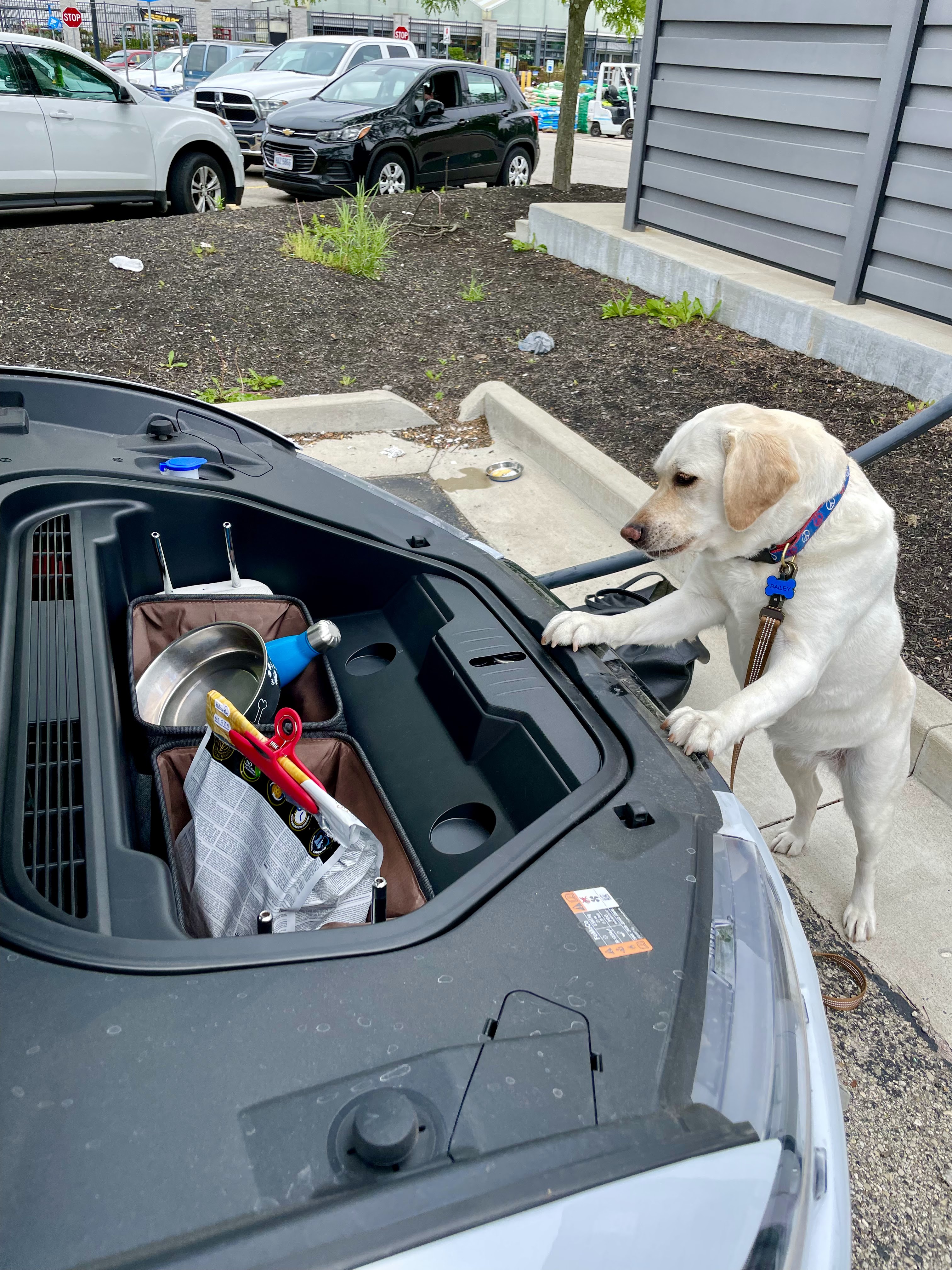
Bailey loves the “Frunk” where we’re stashing all her worldly possessions, such as kibble & dried sardines.


Navigating the Consumer "Pleasure Revenge"​ – advice from Mark Twain, a Surfer and a Futurist Named Popcorn.


The post-pandemic "Pleasure Revenge" is accelerating consumer spending and a return to pre-Covid behaviors.

As the Wall Street Journal recently reported, Americans are returning to gyms in big numbers; booking vacations and plane trips; rocking out at concerts; and going to popcorn-scented movie theaters to see Hollywood blockbusters such as Spider-Man.

What the WSJ missed is that we see this same human behavior after every major shock to the national psyche, as well as the inevitable post-exuberance counter-trend...which brings us to Mark Twain, Faith Popcorn and Laird Hamilton.


"History doesn't repeat itself, but it often rhymes."


Mark Twain told us this would happen.

The national and personal sacrifice endured during WWI was followed by the Roaring Twenties. After WWII, the U.S. economy boomed as Americans bought homes, moved to the suburbs, drove the latest tail-finned beauty from Detroit, and had many, many kids. The economic malaise of the '70s ushered in the 1980s and "Beemer"-driving Yuppies with a voracious appetite for wine, martinis and cigars. And following the severe emotional and economic pain inflicted on 9/11, per capita consumer spending began to steadily climb.

"For every trend, there is a counter-trend."


This "Pleasure Revenge" – popularized by trend expert, Faith Popcorn – taps into a deep human need to soothe pain and maybe even re-exert control over our lives after having had our "normalcy" abruptly taken from us.

But as important as it for businesses to have strategies to profit during the post-crisis Pleasure Revenge, Ms. Popcorn cautions us to think beyond that exuberant period and prepare for the counter-trend, a theme she frequently cites.

What might a counter-trend look like a few years from now? Well, consider that each of those boom periods mentioned above eventually led to an equally large counter-force.

The Roaring Twenties was followed by the Great Depression. The insatiable consumerism of the 1950s and early 60s preceded the economic stagnation of the 1970s. In 1989, Yuppies woke up to Black Monday – their first global economic crisis. The post 9/11 economic growth abruptly crashed in 2008 because of the subprime lending meltdown.

Which brings us to surfing.


"Surfing's one of the few sports that you look ahead to see what's behind."

So what should businesses do? Well, perhaps take inspiration from surfing legend Laird Hamilton. Like a riding a heavy wave, get too far ahead of it and it will crush you; drop in too late and end up nowhere. Timing is everything.

Businesses must invest in products and experiences that satisfy the current unbridled demand and consumer spending.

But as Laird Hamilton advises, be aware of what's following from behind – a big counter trend that may lead to an eventual economic downturn. Best to not invest and expand with a mindset that this frothy consumer spending will never end. It will.

Just ask Mark Twain.

How the Handover Begins

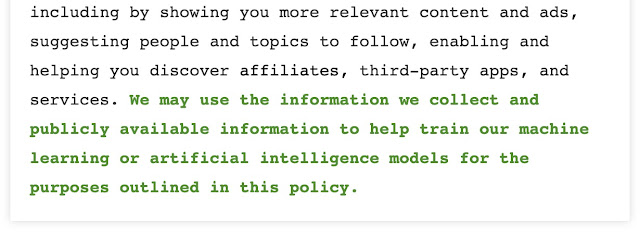
Today’s New York Times features an article that pulls back the curtain on how the AI handover is getting underway, how Google, Meta, X, et a...