Today is the 50th anniversary of Moore's Law. And I'm typing this on a tiny device that is smaller, more powerful and less expensive than any of its predecessors, yet will be larger, less powerful and more expensive than the device I will likely be using in two years time.
I became enamored with the power and clarity of Moore's Law when I worked with Applied Materials to help market the world changing merits of nanotech. Moore's Law is one of the primary reasons why we live in awesome times, and why business is increasingly more productive.
Thank you Gordon Moore.
Never stop learning.
 It was good advice then, it remains vital advice today, given the increasing pace of change.

SXSW Panel: What marketers can learn from political campaigns.
From the emergence of mass media via Television, political campaigns have used the medium with great effect to build belief in their candidates. From Eisenhower’s patriotic “I like Ike” campaign, to LBJ’s “Daisy Girl” commercial, campaigns used the broad appeal of television to create belief. Today, technology has democratized conversations and put power into the hands of real people—emphasis on real.
What can Madison Avenue learn from this transformation?
In this panel, we discuss how brands and marketers can adopt the road-tested tactics of successful political campaigns, including smart data segmentation, rapid response, emotional storytelling, and influencer engagement. By moving supporters up the ladder of engagement and asking them to take more and more meaningful actions on behalf of the things they care about, brands can create a community of advocates prepared to act on their behalf anytime, anywhere.
What's the state of relationships in a digital age?

As humans, we need to be safe; we want to belong; we yearn to be loved; and, most of all, we hope that we matter – to our friends, to our families, within our communities, and to the companies with which we do business. Relationships help satisfy these basic needs. That’s why we seek them. That’s why we need them.
I’ve come to
embrace a simple truth about marketing – what’s true in real life should be true in marketing. Listen
to our vocabulary: Brand
relationships; Customer
relationships; CRM. If our goal truly is to build customer relationships,
then we should dig deeper to better understand how people form real, personal
relationships.
As marketing
becomes increasingly driven by data and technology, we must re-learn how to
forge more personal, more authentic customer relationships. In a digitally-driven world, the 4Es of
personal relationships—empathy, experiences, endorsement and energy—gives marketers
a clear framework for creating relevant and lasting customer relationships.
After
all, to connect with customers that increasingly prize authenticity in
companies and brands, it pays to remember that what is true in life should be
true in marketing.
Meet Generation Z
I don't like the name Gen Z.
Given that this young cohort accounts for nearly 26% of the U.S. population, we could show them a bit more respect by giving them a better name. They are not last in line, as implied by the letter Z, but in fact are at the forefront of new trends that will impact culture and commerce.
Unlike other generational names, Gen Z conveys little insight into the characteristics of this group. Boomers aptly described the population boom that follwed WWII. Gen X drew its name from the cohort's embrace of extreme sports, music and culture. And the term Millennials came about for obvious reasons.
Gen Z (basically anybody under the age 18) will have an enormous impact on the U.S., both from a social and an economic standpoint – they deserve a better name:
- Gen Tech, because they draw inspiration from technology, not just the internet.
- Inclusives, describing their multicultural and co-creative nature.
- Makers, tapping into their desire to build and create, not just watch and share.
Regardless what we call them, we should first get to know them. This presentation from Sparks & Honey is a great starting point.
DE$IGN
This is a good video about the role that design can play in driving commercial success. John Maeda is a graphic designer, computer scientist, author and all around big brain.
A quick peek inside Team Detroit.
My previous post summarized Team Detroit's commitment to training and inspiring the next generation of advertising professionals. This video, produced by our winter crop of interns, gives a peek inside the agency and why it's a great place to grow your career.
David Ogilvy's "teaching hospital" is flourishing in Detroit.

Team Detroit has picked up the baton that David Ogilvy passed to the next generation and are proud to continue his teaching hospital tradition.
 We
start our training with the greenest of the green – our quarterly internship
program, aptly named The Greenhouse. Each quarter we take approximately 15 paid
interns to work throughout our agency – creative, brand integration, digital
marketing, design, media, etc. In addition to
their day-to-day projects, our interns experience job
shadowing, community service, personal branding workshops and
recruiter sessions. (Check out our newest crop in the Greenhouse.)
Our Hi-Potential program enables us to spotlight future leaders and give them the chance to grow and shine, including the opportunity to shape Team Detroit’s presence at NewCo.
But
the heart of our teaching hospital is the training we provide to people at
all levels throughout Team Detroit. We invest in
over 140 training programs covering topics as varied as emotional intelligence, digital
technologies, leadership development, team building, presentation skills and so
much more. Many are in-person workshops;
others use online and mobile technologies to allow people to learn at their own
pace.
It’s
long been true in advertising that the best professional development
comes from the clients with whom we work.
Spend time working with blue chip marketers in complex,
competitive categories and you will get better at your craft.
I’ve
been lucky to count among my clients some of the world’s best-known
companies, including Ford, American Express, The Coca-Cola Company, Sony, Dell,
P&G, Mattel, United Airlines, Hilton, and Callaway Golf. However, my time working in automotive leads
me to believe that this category is probably the best training ground for young
advertising professionals.
Young
people working on an automotive account receive a master class in brand planning,
including brand architecture, portfolio branding and global branding. They learn ethnographic research, trend
analysis, how to balance of rational vs. emotional persuasion.
Working
on a car brand offers exposure to a wide range of career-building skills,
whether through debates on design strategies or the application of predictive
analytics or how to orchestrate successful product launches.
These up and comers will become fluent in retail marketing. This is a category in which brand and retail
must work in harmony. Learning how to match media and incentives
with demand and competitive dynamics is a critical skill.
And since interactive marketing is increasingly central to successful automotive marketing, these digital natives can flourish, whether in analytics, online, mobile or social. (In fact, well over half of Team Detroit is immersed in digital marketing.)
And since interactive marketing is increasingly central to successful automotive marketing, these digital natives can flourish, whether in analytics, online, mobile or social. (In fact, well over half of Team Detroit is immersed in digital marketing.)
Several
times a year I get to play hooky and serve as a guest lecturer at the University of California,
Irvine and at Chapman University. I always describe to these graduate and undergraduate students how much I love what I do
for a living, because a career in advertising allows us to work at
the intersection of business and almost everything imaginable. Nowhere is that more true than in
automotive. And nowhere is that more
passionately embraced than by the 1,500 people at Team Detroit.


Vision of the future, from those likely to invent it.

A fascinating & quick read – POVs from leading thinkers such as Marc Andreessen, Reid Hoffman and others.
Which industries will tech make obsolete? Which technologies will soon be antiquated? What futuristic tech will soon be commonplace.
Subscribe to:
Posts (Atom)
How the Handover Begins
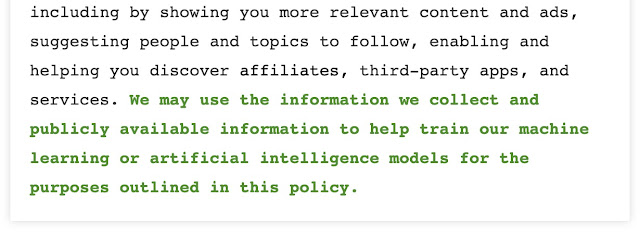
Today’s New York Times features an article that pulls back the curtain on how the AI handover is getting underway, how Google, Meta, X, et a...
-
 I was thinking the other day about the DNA of premium brands . One thing is certain -- it's a relative idea. For example, Hyatt is...
-
 I don't know who authored this quote, but I found it in this video of a presentation Yves Behar gave at TED about the need for design t...
-
 Today’s New York Times features an article that pulls back the curtain on how the AI handover is getting underway, how Google, Meta, X, et a...